β-Caryophyllene oxide
4,12,12-Trimethyl-9-methylene-5-oxatricyclo[8.2.0.0^4,6]dodecane
化学組成 · Constituent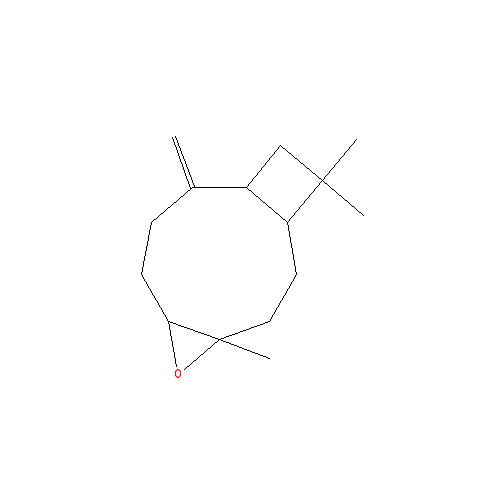
4,12,12-Trimethyl-9-methylene-5-oxatricyclo[8.2.0.0^4,6]dodecane
化学組成 · Constituent
β-Caryophyllene oxide is the natural oxidation product of β-caryophyllene. The compound has weak allergenic activity, low toxicity, and substantial anticancer activity.
Skin. A 48-hour 4 percent patch test on volunteers caused no irritation. Undiluted on rabbit skin under occlusion for 24 hours was moderately irritating. Both a 4 percent maximation test and a 20 percent HRIPT gave no sensitization.
In a 1,511-patient multicenter study, two (0.14 percent) reacted to 3.9 percent. The compound is classified as a moderately strong allergen.
Oral. Acute oral LD50 in rats exceeds 5 g/kg.
Mutagenicity. No mutagenic potential in the Ames test with activation.
Anticancer. Strong induction of glutathione S-transferase in mouse liver and small intestine. Significant activity against six cancer cell lines in vitro.
| Piri-piri | 4.6 – 13.7 % |
| Melissa | 0.8 – 10.0 % |
| Pine (Scots) | 0 – 4.9 % |
| Labdanum | 0 – 4.4 % |
| Angelica root (Himalayan) | 2.0 – 4.0 % |
| Verbena (lemon) | 1.8 – 3.3 % |
| Hyssop (linalool CT) | 1.7 – 3.2 % |
| Echinacea | 3.0 % |
| Carrot seed | 0.3 – 2.8 % |
| Helichrysum (immortelle) | 2.6 % |
| Damiana | 2.5 % |
| Inula | 2.2 % |
| Feverfew | 1.0 – 2.1 % |
| Thyme (borneol CT) | 2.0 % |
| Palmarosa | 0.1 – 1.8 % |
| Lemongrass | 0 – 1.6 % |
| Fern (sweet) | 1.5 % |
| Phoebe | 1.0 – 1.1 % |
| Mastic | tr – 1.1 % |
| Tansy (blue) | 0.5 – 1.0 % |
The major metabolite in rabbits (60 percent) is 14-hydroxycaryophyllene-5,6-oxide.
β-Caryophyllene oxide is among the few naturally occurring epoxides with a benign safety profile. The compound is more stable than β-caryophyllene and contributes warm woody notes to aged oils.