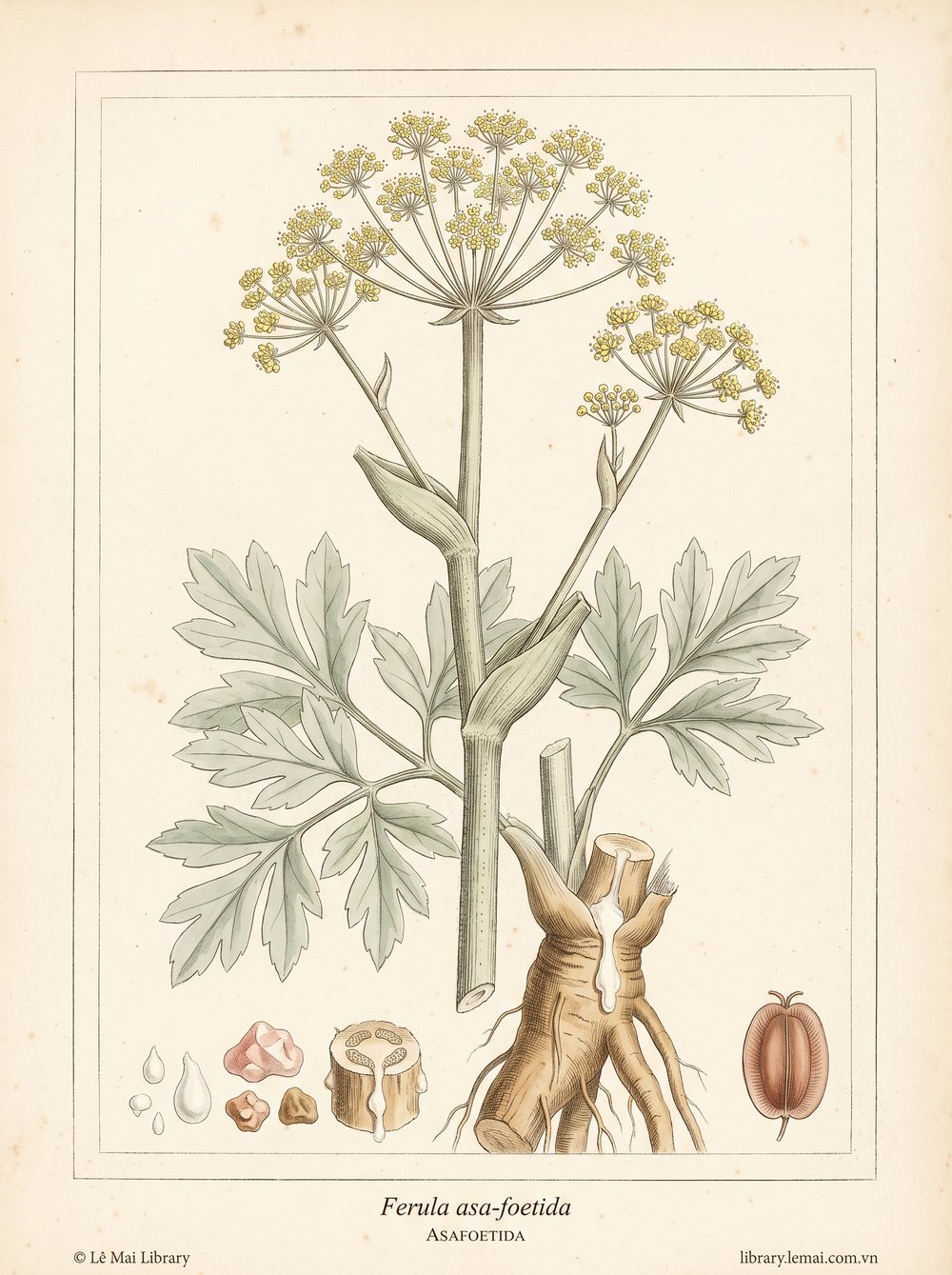
アサフェティダ
A ngùy
Ferula asa-foetida
Devil's dung, Hing, Stinking gum
Possible skin sensitizer due to high sulfur compound content.
No specific skin irritation data for asafoetida oil, but other sulfur-rich essential oils carry similar risks (see Garlic oil).
Caution recommended when blending.
| 1-(Methylthio)propyl (E)-1-propenyl disulfide | 2.7 – 37.9 % |
| 2-Butyl (E)-1-propenyl disulfide | 11.2 – 22.8 % |
| 1-(Methylthio)propyl (Z)-1-propenyl disulfide | 2.6 – 18.5 % |
| α-Pinene | tr – 11.9 % |
| 2-Butyl (Z)-1-propenyl disulfide | 0 – 11.1 % |
| Isobutanol | 0 – 7.7 % |
| β-Pinene | 0.2 – 7.1 % |
| (Z)-β-Ocimene | 0 – 6.1 % |
| (E)-β-Ocimene | 0 – 3.6 % |
Ferula asa-foetida is a large herbaceous plant in the Apiaceae family, native to Iran and Afghanistan.
Roots and stems are incised to collect gum resin. The dried resin solidifies before steam distillation.
Mainly produced in Iran, Afghanistan, Northern India. In Indian cuisine (hing) used widely — heavy dilution during cooking removes most of the strong odor.
Very strong and characteristic odor — hence the name devil's dung.
In traditional Ayurvedic and Traditional Chinese Medicine, asafoetida is used for digestive disorders, bronchitis, spasms.
Most sulfur-rich essential oils (garlic, onion, asafoetida) require caution when blending.