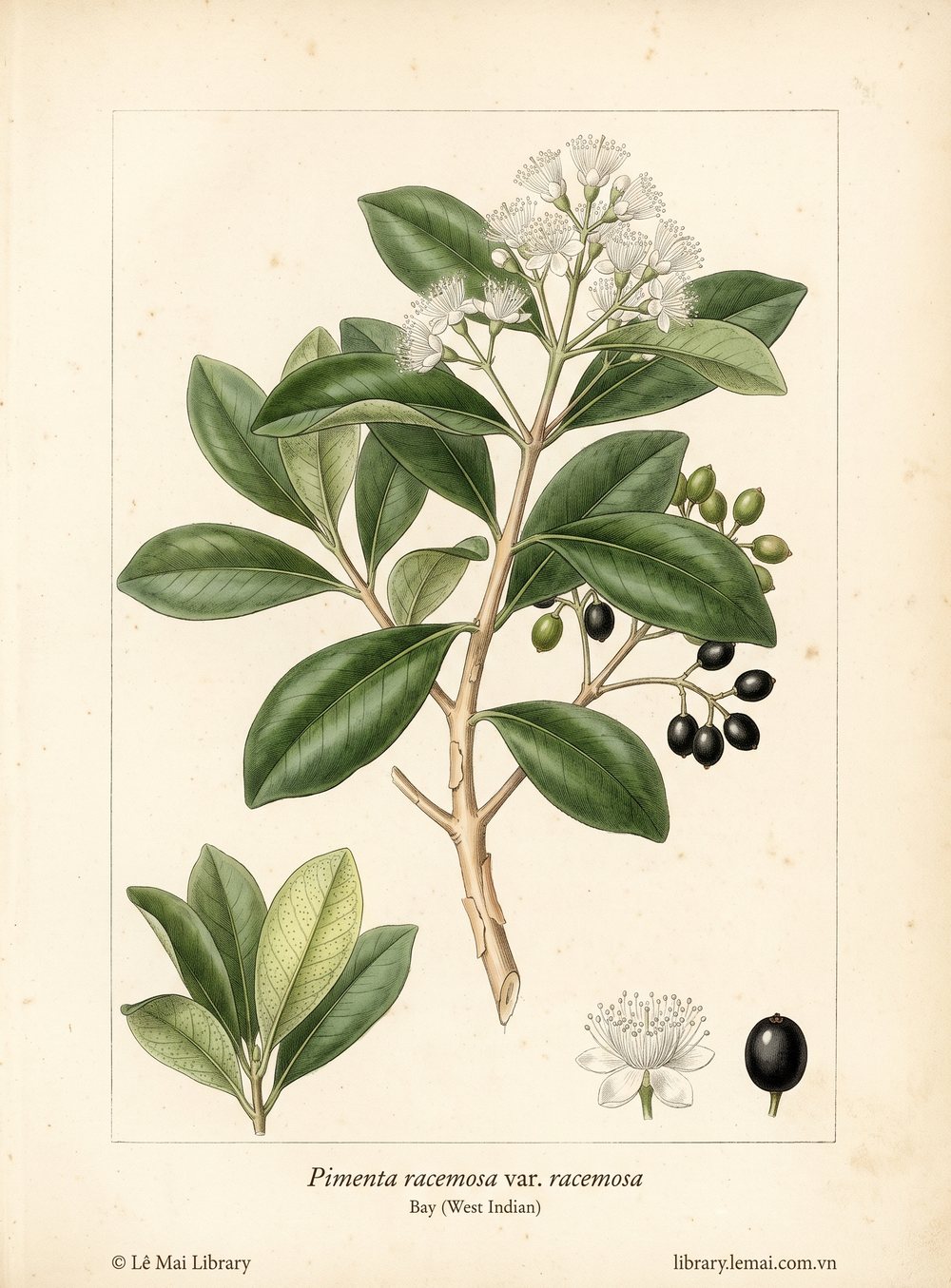
ウエストインディアンベイ
Nguyệt quế Tây Ấn
Pimenta racemosa var. racemosa
Bay rum tree, Pimenta acris
May contain estragole and methyleugenol. May inhibit blood clotting due to high eugenol. Low risk of skin sensitization. Low risk of mucous membrane irritation.
Oral: caution with pethidine, MAOIs, SSRIs. Avoid with anticoagulant medication, before major surgery, peptic ulcer, hemophilia.
Maximum adult oral dose 50 mg daily.
Maximum dermal use level 0.9 percent, based on eugenol content and a dermal limit of 0.5 percent. Methyleugenol present at 0, 1.4 percent requires its own limit.
| Eugenol | 44.4 – 56.2 % |
| β-Myrcene | 6.4 – 25.0 % |
| Chavicol | 9.3 – 21.6 % |
| Linalool | 1.7 – 6.0 % |
| (+)-Limonene | 0.8 – 3.9 % |
| 1-Octen-3-ol | 0.9 – 2.0 % |
| 1,8-Cineole | 0.2 – 1.4 % |
| Methyleugenol | 0 – 1.4 % |
| (E)-β-Ocimene | 0 – 1.4 % |
| Terpinen-4-ol | 0.3 – 1.2 % |
| 3-Octanone | 0.8 – 1.1 % |
| δ-Cadinene | 0.6 – 1.0 % |
| p-Cymene | 0.1 – 1.0 % |
| Estragole | tr, 0.1 % |
Pimenta racemosa is a tree native to the Caribbean, particularly Dominica. The leaves are hydro-distilled.
After distillation the oil separates into two fractions, one lighter and one heavier than water. The two fractions are recombined to form the commercial oil.
Three chemotypes of var. racemosa exist: clove (eugenol), lemon (citral), and anise (estragole/methyleugenol). Only the eugenol chemotype is commercially produced.
Not to be confused with laurel leaf oil (Laurus nobilis), which is also called bay leaf.
Methyleugenol content varies significantly by region. Dominica analysis in 1991 found none; Guadaloupe in 1995 found 1.4 percent; Jamaica in 2007 found 1.02 percent. Request a detailed certificate of analysis from the supplier.
Bay rum oil is the traditional base for bay rum cologne produced in the Virgin Islands since the nineteenth century.