(E)-Anethole
(E)-4-Methoxy-(1-propenyl)benzene
trans-Anethole · p-trans-Propenylanisole · Anise camphor
化学組成 · Constituent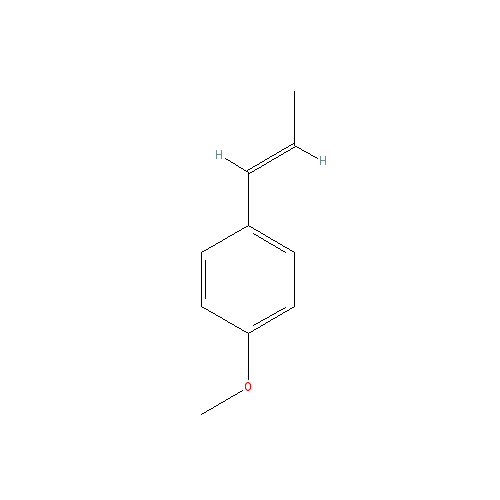
(E)-4-Methoxy-(1-propenyl)benzene
trans-Anethole · p-trans-Propenylanisole · Anise camphor
化学組成 · Constituent
(E)-Anethole is the dominant constituent in anise and sweet fennel oils, often above 90 percent. It is safe for topical use at standard concentrations, but its weak estrogen-like activity calls for caution during pregnancy and certain endocrine conditions.
Skin. A 2 percent patch test on human subjects showed no irritation or sensitization. Among patients sensitive to star anise oil, 5 of 15 reacted positively to (E)-anethole itself. Aged or air-exposed material oxidizes to (Z)-anethole, anisaldehyde and anisic ketone, which may raise sensitization risk.
Oral. Acute oral LD50 is 2.09 to 3.20 g/kg in rats. Rats fed 10,000 ppm for 15 weeks showed mild hepatocyte changes in males only. At 2,500 ppm for one year, no adverse effects were observed.
Reproductive. (E)-Anethole shows estrogen-like activity in vitro, many times weaker than endogenous estrogens. Oils high in anethole should be avoided in pregnancy, breastfeeding, endometriosis and estrogen-dependent cancers.
Liver. High doses cause mild hepatic changes in female rats, mainly via the metabolite anethole 1',2'-epoxide. Low doses are efficiently detoxified through O-demethylation and omega-oxidation.
Mutagenicity and carcinogenicity. Ames test results are inconsistent; genotoxic potential is low. No significant carcinogenicity in long-term rat or mouse studies.
| Anise | 75.2 – 96.1 % |
| Myrtle (aniseed) | 95.0 % |
| Fennel (sweet) | 58.1 – 92.5 % |
| Anise (star) | 71.2 – 91.8 % |
| Fennel (bitter) | 52.5 – 84.3 % |
| Betel | 0 – 7.8 % |
| Damiana | 1.0 % |
(E)-Anethole is distributed and metabolized similarly in rats, rabbits and humans. Most of an oral dose is excreted within 48 hours through urine. After intravenous dosing, the compound accumulates mainly in liver, lungs and brain.
Three principal metabolic pathways. O-demethylation yields para-hydroxyl propenylbenzene. N-oxidation. Epoxidation produces anethole 1',2'-epoxide, a reactive intermediate; in humans this is a minor pathway at around 3 percent of total flux.
At low doses, epoxidation is minor. At high doses in female rats the metabolic flux shifts toward epoxidation, producing more epoxide and explaining the higher hepatotoxicity observed in this sex.
(E)-Anethole is structurally close to estragole and safrole, two compounds with higher carcinogenic risk. Its metabolic profile, however, is markedly different and substantially safer.
The compound also inhibits platelet aggregation, so oral use of anise oils warrants caution alongside anticoagulant therapy, before major surgery, childbirth, peptic ulcer or other bleeding disorders.