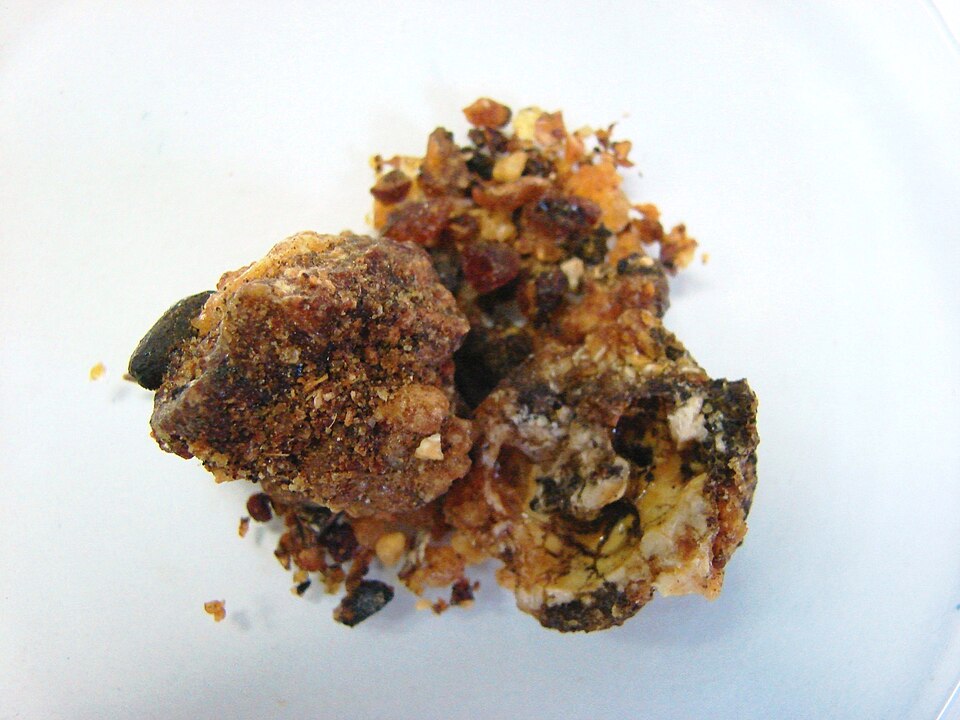
オポポナックス
Opopanax, Mộc dược ngọt
Commiphora guidottii
Sweet myrrh, Bisabol myrrh
Low skin sensitization risk.
Some reports of phototoxicity at high concentrations, though data is inconclusive. Dermal limit recommended for sun-exposed applications.
Not recommended in pregnancy, opopanax is in the same family as myrrh, with potentially similar effects.
| α-Bisabolene | 10.0 – 25.0 % |
| β-Bisabolene | 8.0 – 15.0 % |
| γ-Bisabolene | 5.0 – 12.0 % |
| α-Santalene | 5.0 – 10.0 % |
| β-Caryophyllene | 3.0 – 8.0 % |
Commiphora guidottii is a tree from the semi-arid regions of East Africa, particularly Somalia and Ethiopia.
When the trunk bark is damaged, yellow-orange sap flows out. It hardens into resin called opopanax or sweet myrrh.
The essential oil is distilled from the resin. Small-scale production.
Family Burseraceae, same family as myrrh (Commiphora myrrha) and frankincense (Boswellia).
Aroma close to myrrh but sweeter and more balsamic, hence the name 'sweet myrrh'.
In perfumery, opopanax is an important oriental base note. In incense, opopanax and myrrh are often used together.