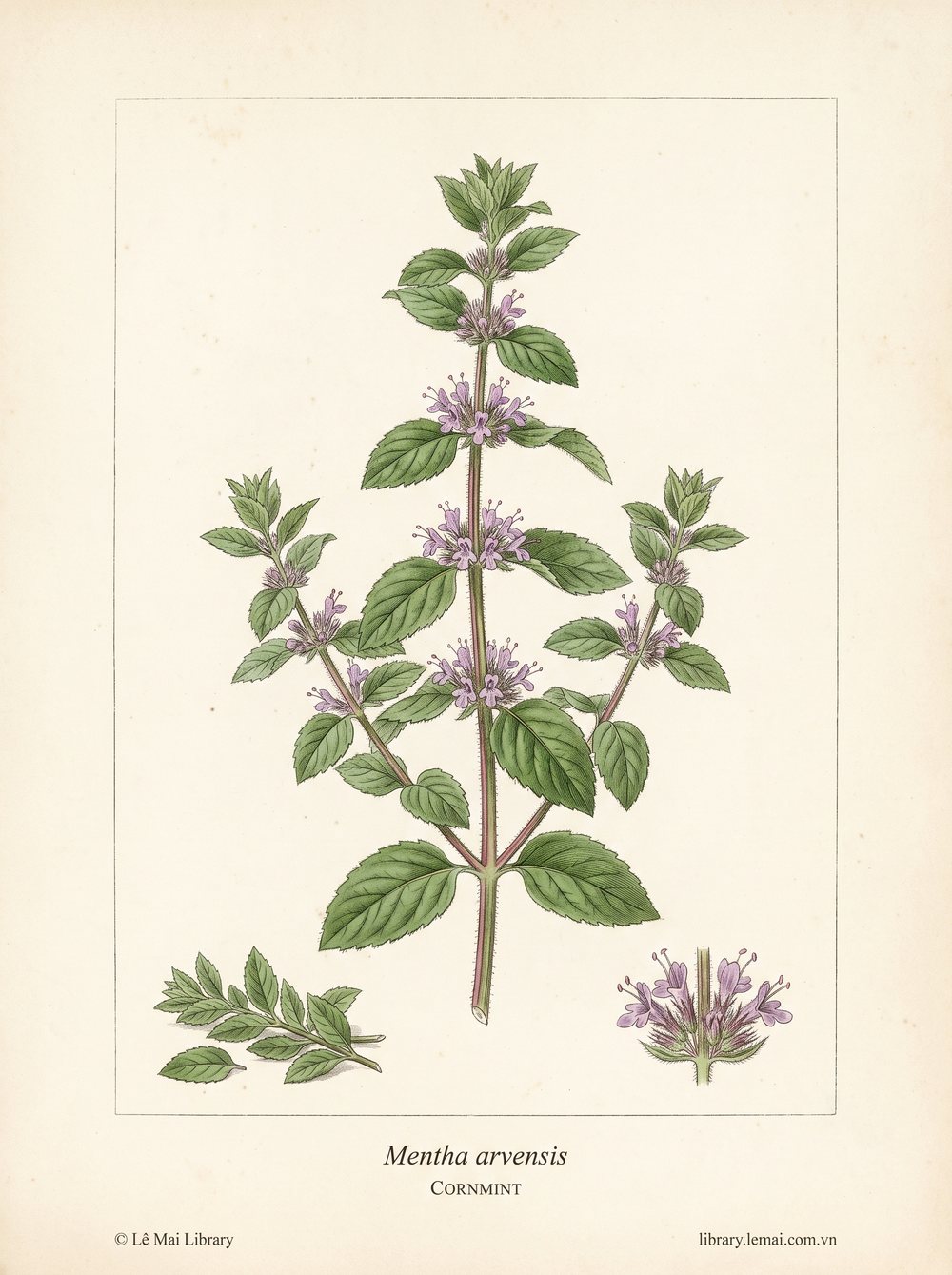
コーンミント
Bạc hà ruộng
Mentha arvensis
Japanese mint, Dementholized cornmint
May be choleretic. Low risk of mucous membrane irritation.
Broad contraindications: cardiac fibrillation, G6PD deficiency. Do not apply to or near the face of infants or children.
Oral: contraindicated in cholestasis. Caution in GERD.
G6PD deficiency is an inheritable enzyme disorder common in people of Chinese, West African, Mediterranean or Middle Eastern origin. Those with it are usually advised to avoid sulfonamides, chloramphenicol, antimalarials, aspirin.
Cases of neonatal jaundice have been reported when menthol-containing umbilical stump dressings were used on G6PD-deficient infants.
| (−)-Menthol | 28.8 – 34.7 % |
| Menthone | 16.3 – 31.1 % |
| Isomenthone | 6.8 – 12.1 % |
| (+)-Limonene | 5.8 – 9.6 % |
| β-Pinene | 2.0 – 4.5 % |
| α-Pinene | 2.0 – 4.3 % |
| Neomenthol | 2.5 – 4.1 % |
| Piperitone | 0.6 – 3.8 % |
| Menthyl acetate | 1.8 – 3.4 % |
| 3-Octanol | 0.4 – 2.4 % |
| Menthofuran | 0.4 – 0.6 % |
Mentha arvensis is a perennial herb of the Northern Hemisphere temperate zone. The natural oil contains 70 to 90 percent menthol, too high for direct use.
Commercial process: freeze the crude oil to crystallize menthol, filter out about 50 percent. The remaining oil is 'dementholized cornmint', the common commercial form.
Family Lamiaceae. Cornmint oil is sometimes used as an adulterant for peppermint oil.
Cornmint oil is not adulterated, as it is not a commercially attractive target for adulteration.