Menthone
2-(1-Methylethyl)-5-methylcyclohexanone
1-Methyl-4-isopropylcyclohexan-3-one · p-Menthan-3-one
化学組成 · Constituent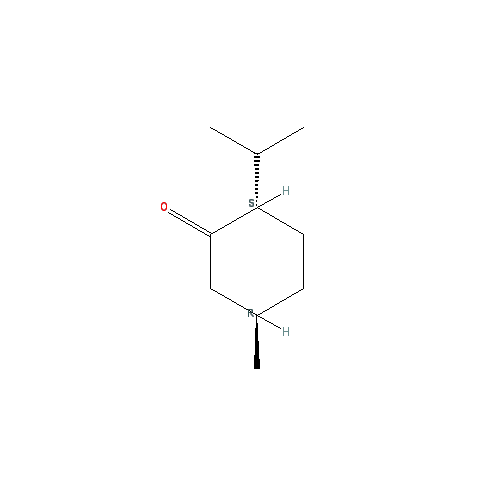
2-(1-Methylethyl)-5-methylcyclohexanone
1-Methyl-4-isopropylcyclohexan-3-one · p-Menthan-3-one
化学組成 · Constituent
Menthone is a monoterpenoid ketone present in several mint oils and buchu. Shows signs of subchronic toxicity at high doses.
Subchronic toxicity. In a 28-day rat study, menthone caused cerebellar lesions at 400 and 800 mg/kg/day but not at 200 mg/kg/day. Dose-dependent increases were seen in plasma creatinine, bilirubin and alkaline phosphatase. Relative liver and spleen weights increased.
Acute toxicity. Subcutaneous LD50 in mice is 2.18 g/kg.
Mutagenicity. Menthone is mutagenic in the Ames test and genotoxic in fruit flies.
Cancer. In a mouse study, ip injection of menthone did not produce lung tumors.
| Calamint (lesser) | 7.0 – 55.8 % |
| Peppermint | 8.0 – 31.6 % |
| Cornmint | 16.3 – 31.1 % |
| Buchu (diosphenol CT) | 2.5 – 25 % |
| Pennyroyal | 0.6 – 16.0 % |
| Buchu (pulegone CT) | 1.3 – 7.0 % |
| Geranium | 0.1 – 2.4 % |
| Spearmint | 0.1 – 1.7 % |
(-)-Menthone is excreted in rabbits as a glucuronide conjugate, with 10 to 15 percent metabolized to (+)-neomenthol. The compound shows significant radical scavenging activity against DPPH and OH radicals.