Isoeugenol
2-Methoxy-4-(1-propenyl)phenol
2-Methoxy-4-(2-methylvinyl)phenol · 4-Propenylguaiacol
化学組成 · Constituent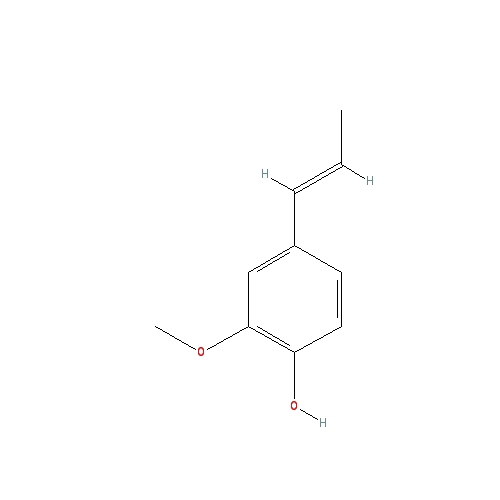
2-Methoxy-4-(1-propenyl)phenol
2-Methoxy-4-(2-methylvinyl)phenol · 4-Propenylguaiacol
化学組成 · Constituent
Isoeugenol is the positional isomer of eugenol, one of the most allergenic fragrance materials according to the EU. As a substituted phenol it is a weak acid that may be corrosive to tissues.
Skin. A 48-hour patch test at 32 percent in acetone caused moderate irritation. At 5 percent it produced erythema in 3 of 35 volunteers. At 8 percent RIFM identified sensitization. No reactions at 5 percent on 100 volunteers or 0.2 percent on 20 healthy volunteers.
Dermatitis patients. Reaction rates to 1 percent isoeugenol vary from 0.8 to 1.8 percent in large European studies. Among fragrance-sensitive groups, 25 percent reacted to 2 percent. Of 19 patients known to be fragrance-allergic, 4 still reacted at 0.01 percent.
Oral. Acute oral LD50 in rats is 1.56 g/kg, in guinea pigs 1.41 g/kg.
Subchronic. A 14-week study at 37.5 to 600 mg/kg/day established a general NOAEL of 75 mg/kg. In male mice there was a dose-dependent increase in relative liver weight at all dosed groups.
Cardiovascular. Isoeugenol shows in vitro antiplatelet aggregation activity.
Kidney. Protective against cisplatin nephrotoxicity in rats.
Reproductive. In pregnant rats, developmental NOAEL was 500 mg/kg/day. At the highest dose of 1,000 mg/kg/day there was reduced fetal body weight gain and a skeletal variation.
Mutagenicity and cancer. Not mutagenic in Ames or Saccharomyces tests. In a 2-year oral study, hepatocellular carcinomas occurred in 18 of 50 male mice in each dosed group, compared to 8 of 50 controls. No carcinogenicity was seen in female mice or rats of either sex.
| Calamus (tetraploid form) | 2.3 – 25.0 % |
| Ginger lily | 18.4 % |
| Betel | 0 – 10.6 % |
| Tuberose | 2.6 % |
| Basil (pungent) | 2.4 % |
| Vetiver | 0 – 1.3 % |
| Karo karoundé | 0.5 % |
| Ylang-ylang | 0 – 0.5 % |
| Clove stem | 0.1 – 0.4 % |
| Clove bud | 0.1 – 0.2 % |
| Mace | 0 – 0.1 % |
After oral administration in rats, more than 85 percent of isoeugenol is excreted in urine primarily as sulfate or glucuronide metabolites within 72 hours. About 10 percent is recovered in feces, less than 0.1 percent as CO2 or expired organics. At 72 hours less than 0.25 percent of the dose remains in tissues.
The cancer profile of isoeugenol mirrors that of eugenol: liver tumors only in male mice and not dose-dependent, with none seen in female mice or rats of either sex. This pattern is typical of weak or moderate carcinogens in some rodents but not humans. The increased liver weight is a function of a higher metabolic rate.
Strict restrictions for dermal application seem justified but will have only a minimal impact on the use of essential oils in aromatherapy since isoeugenol occupies only a small fraction in most oils.