Terpinyl acetate
α,α,4-Trimethylcyclohex-3-enylmethyl ethanoate
α-Terpinyl acetate · p-Menth-1-en-8-ol acetate · α-Terpineol acetate
化学組成 · Constituent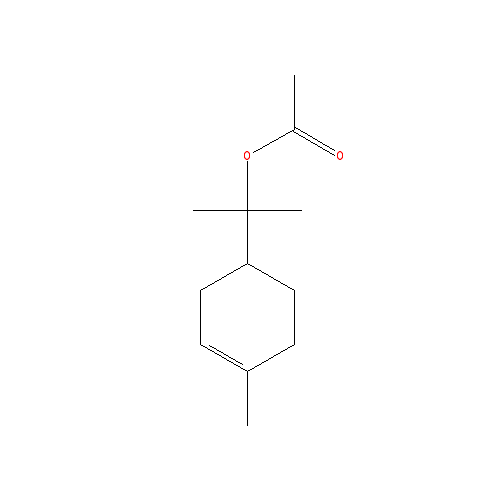
α,α,4-Trimethylcyclohex-3-enylmethyl ethanoate
α-Terpinyl acetate · p-Menth-1-en-8-ol acetate · α-Terpineol acetate
化学組成 · Constituent
Terpinyl acetate, mainly the α isomer, is the principal constituent of cardamom and lovage leaf oils. The compound is safe at standard concentrations.
Skin. At 5 percent on 25 volunteers it was neither irritating nor sensitizing. At 10 percent mixed with 15 percent mixed isomer terpineol on 179 dermatitis patients suspected of cosmetic allergy, no reactions occurred. In 100 patients at 5 percent there were no reactions.
Oral. Acute oral LD50 in rats was 5.1 g/kg, a high value typical of low-toxicity compounds.
Subchronic. Rats fed 1,000, 2,500 or 10,000 ppm for 20 weeks showed no adverse effects.
Inhalation. Chronic terpinyl acetate vapor inhalation in animals causes changes in the central nervous system, blood and liver. The minimum active concentration is 10 mg/m3.
| Lovage leaf | 43.4 – 47.3 % |
| Cardamon | 29.2 – 39.7 % |
| Sage (Spanish) | 0 – 15.5 % |
| Betel | 6.8 – 11.0 % |
| Hinoki leaf | 9.1 % |
| Hinoki root | 9.1 % |
| Lemon leaf | tr – 7.3 % |
| Laurel leaf | 4.5 – 7.0 % |
| Cypress | 4.1 – 6.4 % |
| Juniper (Phoenician) | 0 – 4.6 % |
| Myrtle | 0 – 4.4 % |
| Lovage seed | 3.1 % |
| Thuja | 1.0 – 1.8 % |
α-Terpinyl acetate plays a central role in the sweet floral character of cardamom and is a widely used ester in perfumery.