(E)-Ethyl cinnamate
(E)-Ethyl 3-phenylpropenoate
trans-Ethyl cinnamate · Ethyl cinnamate · trans-Cinnamic acid ethyl ester
化学組成 · Constituent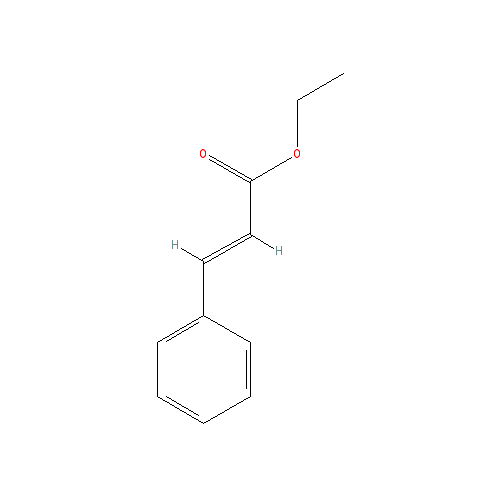
(E)-Ethyl 3-phenylpropenoate
trans-Ethyl cinnamate · Ethyl cinnamate · trans-Cinnamic acid ethyl ester
化学組成 · Constituent
(E)-Ethyl cinnamate is a phenylpropenoid ester occurring in a few floral and balsamic essential oils.
Skin. Applied undiluted to rabbit skin it was non-irritating. A 4 percent patch test on humans produced neither irritation nor sensitization. In one older study, 1 of 22 individuals reacted positively to undiluted material.
Oral and dermal. Acute oral LD50 in rats is 4.0 to 7.8 g/kg. Acute dermal LD50 in rabbits exceeds 5 g/kg.
Photo. UV spectra data indicate no potential for phototoxicity or photoallergy.
Reproductive. Did not bind to estrogen receptors in female rat uterus tissue.
Mutagenicity. Not mutagenic in the Ames test but produced marginal CA in Chinese hamster fibroblasts.
| Maraba | 13.2 – 16.5 % |
| Narcissus | 0.5 – 5.6 % |
| Bakul | 1.9 % |
| Benzoin | 0.8 – 1.0 % |
| Tolu balsam | 0.8 % |
(E)-Ethyl cinnamate is used as a balsamic-honey note in perfumery, particularly for narcissus and benzoin accords.