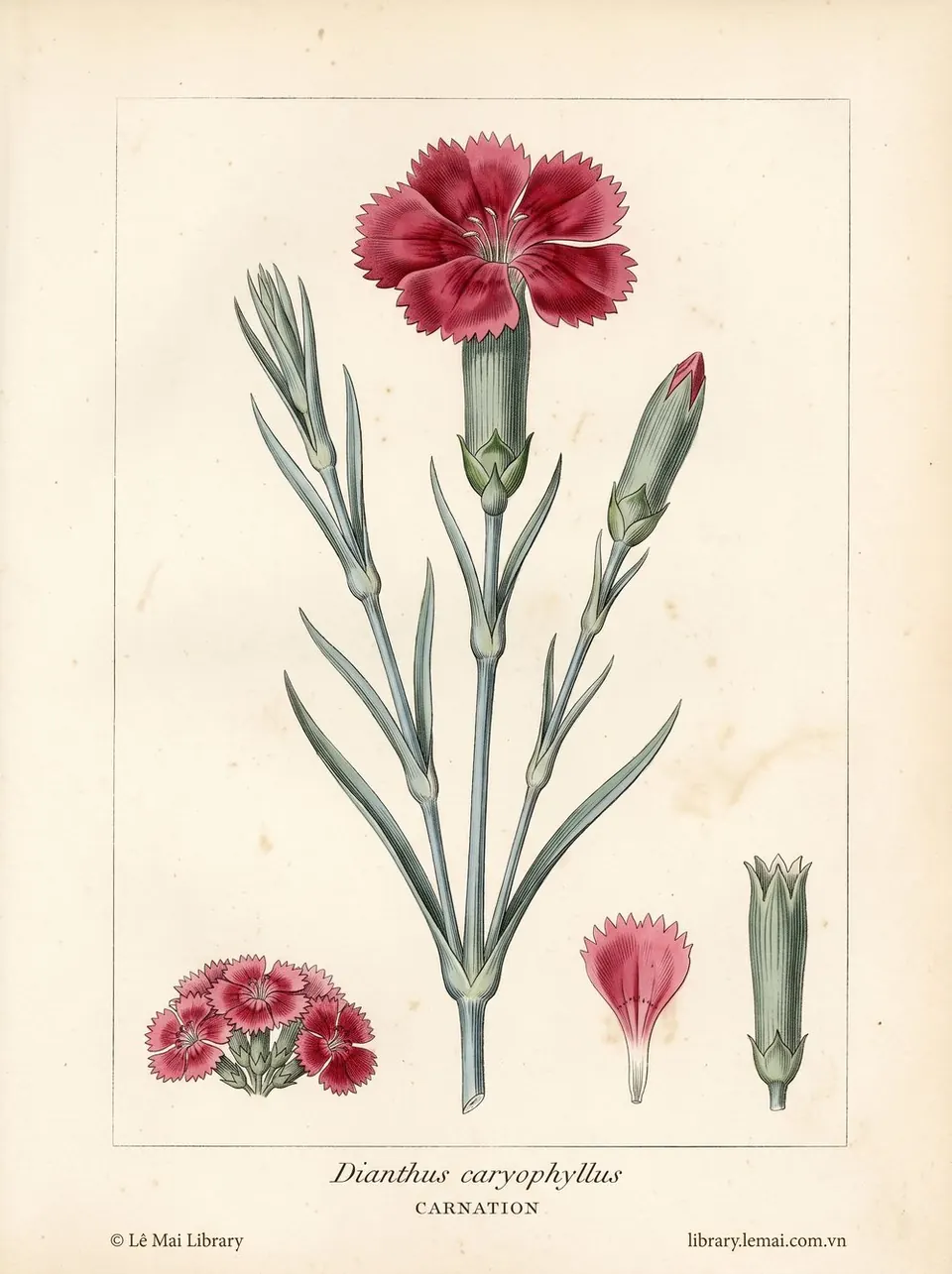
カーネーション
Cẩm chướng
Dianthus caryophyllus
Clove pink
Carnation absolute is solvent-extracted from the flowers of Dianthus caryophyllus, a Mediterranean member of the pink family; its folk name, clove pink, hints at its scent. Its main components include benzyl benzoate (about 5 to 14.6%) and eugenol. Supply is limited, and it suits spicy floral perfumes.
Updated 6 Nov 2026 · Lê Mai Team
No specific contraindications in available data.
Maximum dermal use level 13.9 percent, based on 3.6 percent eugenol and a dermal limit of 0.5 percent for eugenol.
Benzyl benzoate and benzyl salicylate are listed as allergens by the EU, but the practical risk is negligible.
| Benzyl benzoate | 5.0 – 14.6 % |
| Pentacosene | 8.1 % |
| Benzyl salicylate | 3.9 % |
| Eugenol | 1.7 – 3.6 % |
| Heptacosene | 2.7 % |
| Methyl linoleate | 2.3 % |
| Tricosene | 1.4 % |
Dianthus caryophyllus is the traditional carnation, native to the Mediterranean. The folk name 'clove pink' reflects the clove-like note of the flowers.
The absolute is solvent-extracted from the flowers. The constituent data above is for the Egyptian absolute.
Family Caryophyllaceae. Limited availability, high cost.
| Après l'Ondée | Guerlain · 1906 · main note |
| L'Heure Bleue | Guerlain · 1912 · heart |
| Bellodgia | Caron · 1927 · main note |
| L'Air du Temps | Nina Ricci · 1948 · heart |
| Opium | Yves Saint Laurent · 1977 · heart |
Based on note lists published by each house. Fragrance names and marks belong to their owners.
Due to its high cost, carnation absolute is unlikely to be used at a concentration sufficient to cause adverse skin reactions.