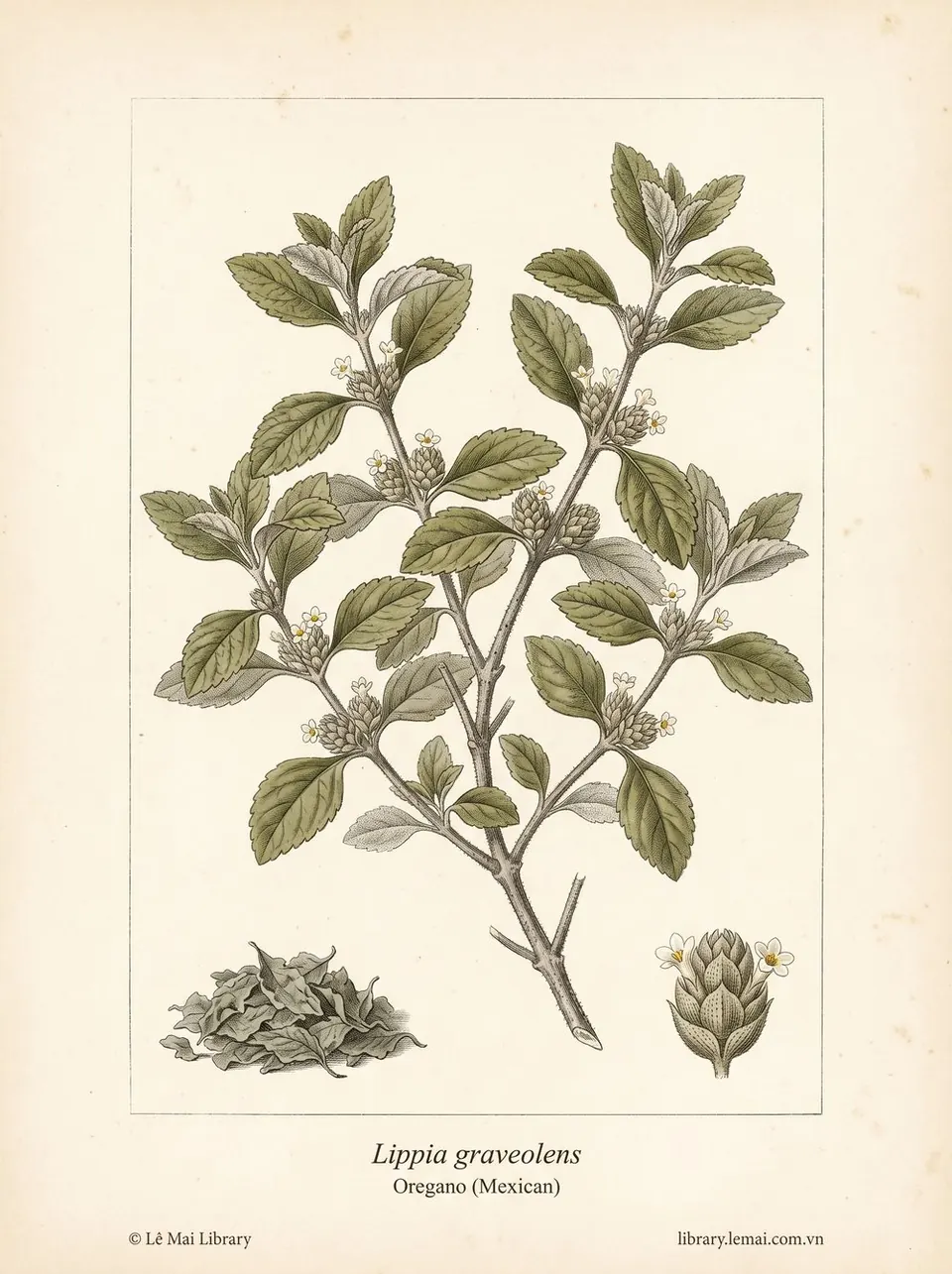
メキシカンオレガノ
Kinh giới Mexico
Lippia graveolens
Mexican wild sage
Mexican oregano essential oil is steam-distilled from the leaves of Lippia graveolens, a shrub of the verbena family from Mexico and Central America; despite the name, it is not related to European oregano. It smells close to oregano; its main components are carvacrol and thymol, together up to 60%. It irritates skin at high concentrations and should be avoided during pregnancy and breastfeeding.
Updated 6 Nov 2026 · Lê Mai Team
Carvacrol and thymol together up to 60 percent. Profile close to Origanum vulgare but from a different plant family.
Dermal caution: high concentrations are irritating. Oral caution: anticoagulants and antidiabetics.
Not recommended in pregnancy and breastfeeding.
| Carvacrol | 30.0 – 60.0 % |
| Thymol | 5.0 – 25.0 % |
| p-Cymene | 8.0 – 18.0 % |
| γ-Terpinene | 2.0 – 10.0 % |
Lippia graveolens is a shrub from Mexico and Central America. Used as a local seasoning in place of European oregano in Mexican cuisine.
Despite the shared name, Lippia graveolens and Origanum vulgare belong to two different plant families, Verbenaceae and Lamiaceae. The common name reflects similar aroma and chemistry.
Family Verbenaceae.
In Mexican cuisine, Mexican oregano has a stronger and slightly more citrus character than European oregano. Pairs with mole, tamale, and grilled meats.
Limited oil production, mainly Mexico.