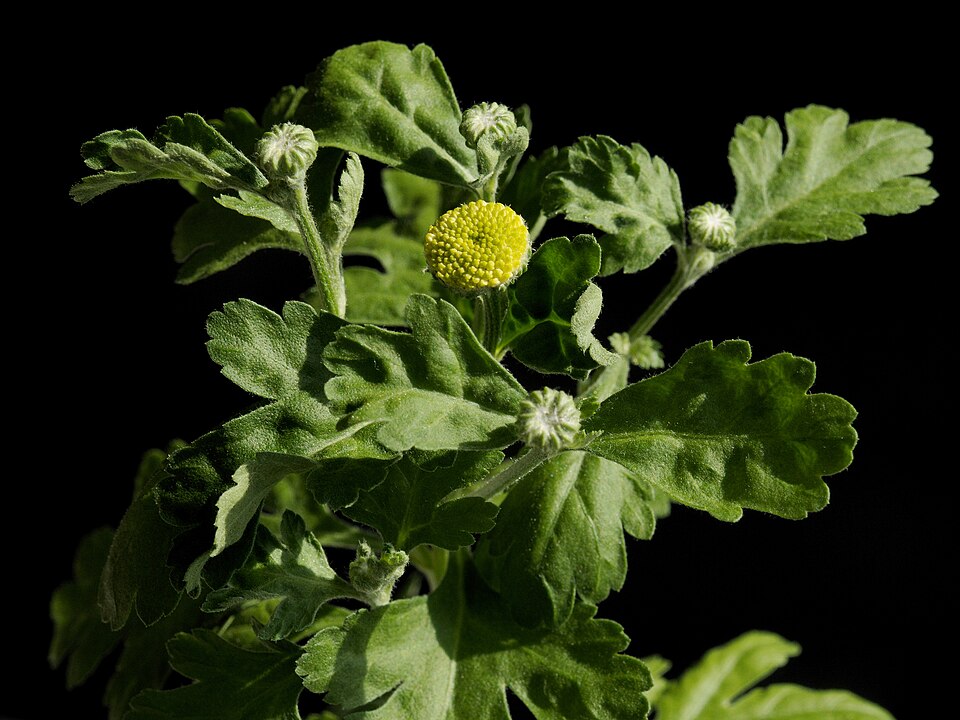
フィーバーフュー
Cúc đại bi
Tanacetum parthenium
Nosebleed, Midsummer daisy, Chrysanthemum parthenium
Moderate neurotoxicity due to high camphor content (28 to 44 percent).
Broad contraindications: pregnancy, breastfeeding.
Maximum adult oral dose 318 mg daily. Maximum dermal use level 10 percent.
Basis: 44.2 percent camphor, with oral limit 2 mg per kg and dermal 4.5 percent.
The high camphor content suggests this oil is unsafe in pregnancy and breastfeeding.
| Camphor | 28.0 – 44.2 % |
| (E)-Chrysanthenyl acetate | 22.9 – 30.2 % |
| Camphene | 5.4 – 7.7 % |
| Germacrene D | 0.7 – 4.6 % |
| α-Terpinene | 2.2 – 3.8 % |
| p-Cymene | 0.6 – 3.1 % |
| β-Farnesene | 0.8 – 3.0 % |
| Terpinen-4-ol | 0.3 – 2.8 % |
| γ-Terpinene | 1.0 – 2.7 % |
| α-Pinene | 1.0 – 2.4 % |
| Caryophyllene oxide | 1.0 – 2.1 % |
| (E)-Chrysanthenol | 1.3 – 2.0 % |
| Bornyl acetate | 0.7 – 1.9 % |
Tanacetum parthenium is a perennial herb of the Balkans, naturalized across Europe and North America. Small leaves, small daisy-like flowers.
The oil is steam-distilled from the leaves. Limited availability.
Family Asteraceae. In traditional medicine, feverfew leaves are used for migraine, an effect scientifically studied, attributed to parthenolide (a sesquiterpene lactone not present in the aromatic essential oil).