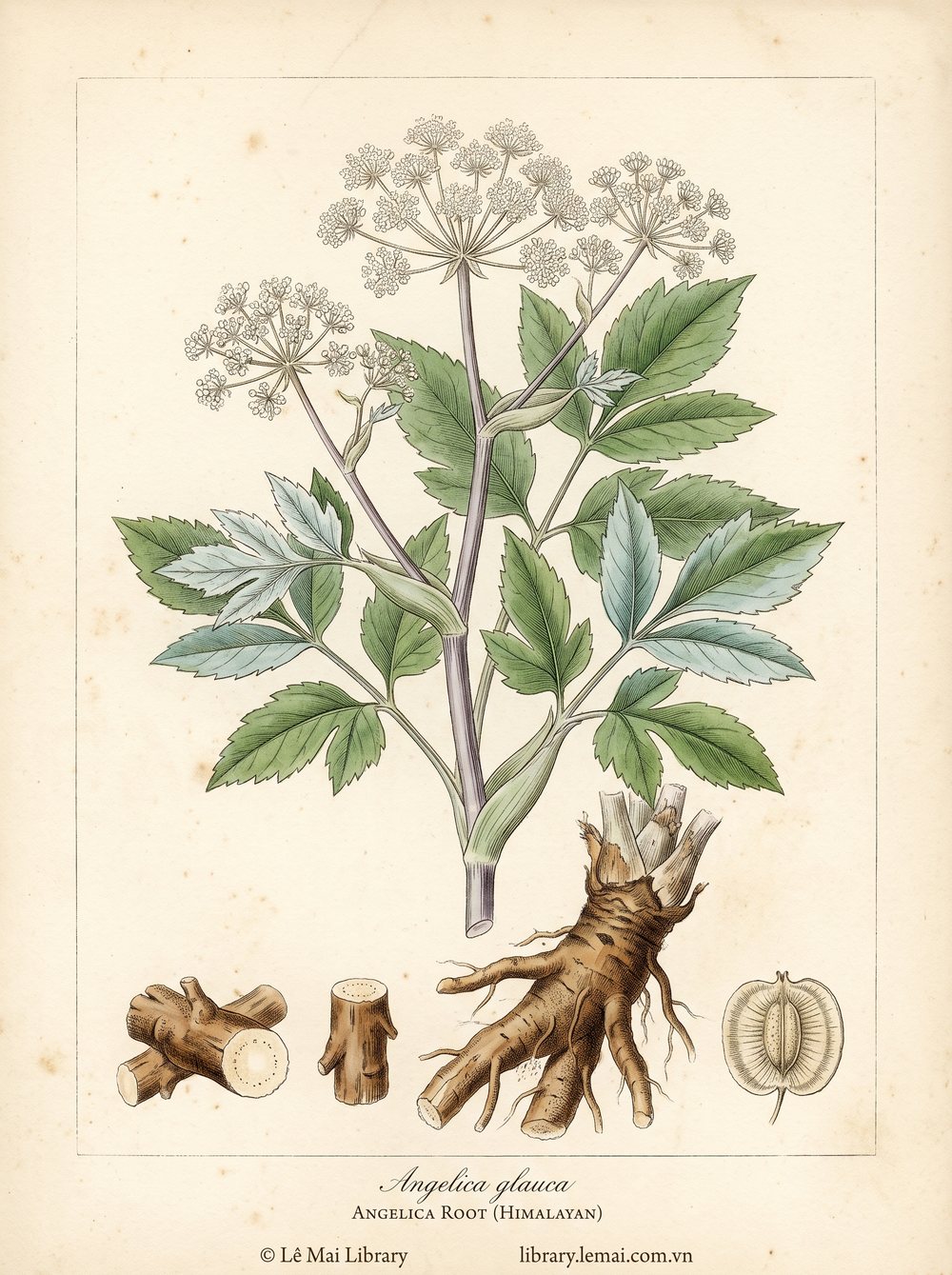
ヒマラヤアンジェリカ
Đương quy Himalaya (rễ)
Angelica glauca
Smooth angelica
No known hazards.
No specific skin reaction data for Himalayan angelica root oil.
3-Butylidene phthalide tested at 2% on 25 volunteers, neither irritating nor sensitizing.
Contains no known carcinogens. 3-Butylidene phthalide and (Z)-ligustilide are cytotoxic to colon cancer cells in vitro.
| (Z)-3-Butylidene phthalide | 11.3 – 20.5 % |
| (Z)-Ligustilide | 5.2 – 20.4 % |
| 3-Methyl oct-2-ene | 6.0 – 13.8 % |
| (E)-Ligustilide | 0.5 – 12.4 % |
| Camphene | 3.0 – 6.0 % |
| β-Pinene | 2.0 – 5.3 % |
| β-Phellandrene | 0.8 – 4.6 % |
| β-Caryophyllene oxide | 2.0 – 4.0 % |
| Citronellyl acetate | 2.2 – 3.4 % |
| Citronellol | 1.5 – 3.0 % |
Angelica glauca is a herbaceous plant in the Apiaceae family, native to the Himalayas.
Roots are harvested and steam-distilled.
Limited production in India.
Unlike Angelica archangelica (regular angelica root), the Himalayan variant does NOT contain furocoumarins — not phototoxic.
Several reports on neuroprotective effects of (Z)-ligustilide.
Limited availability.