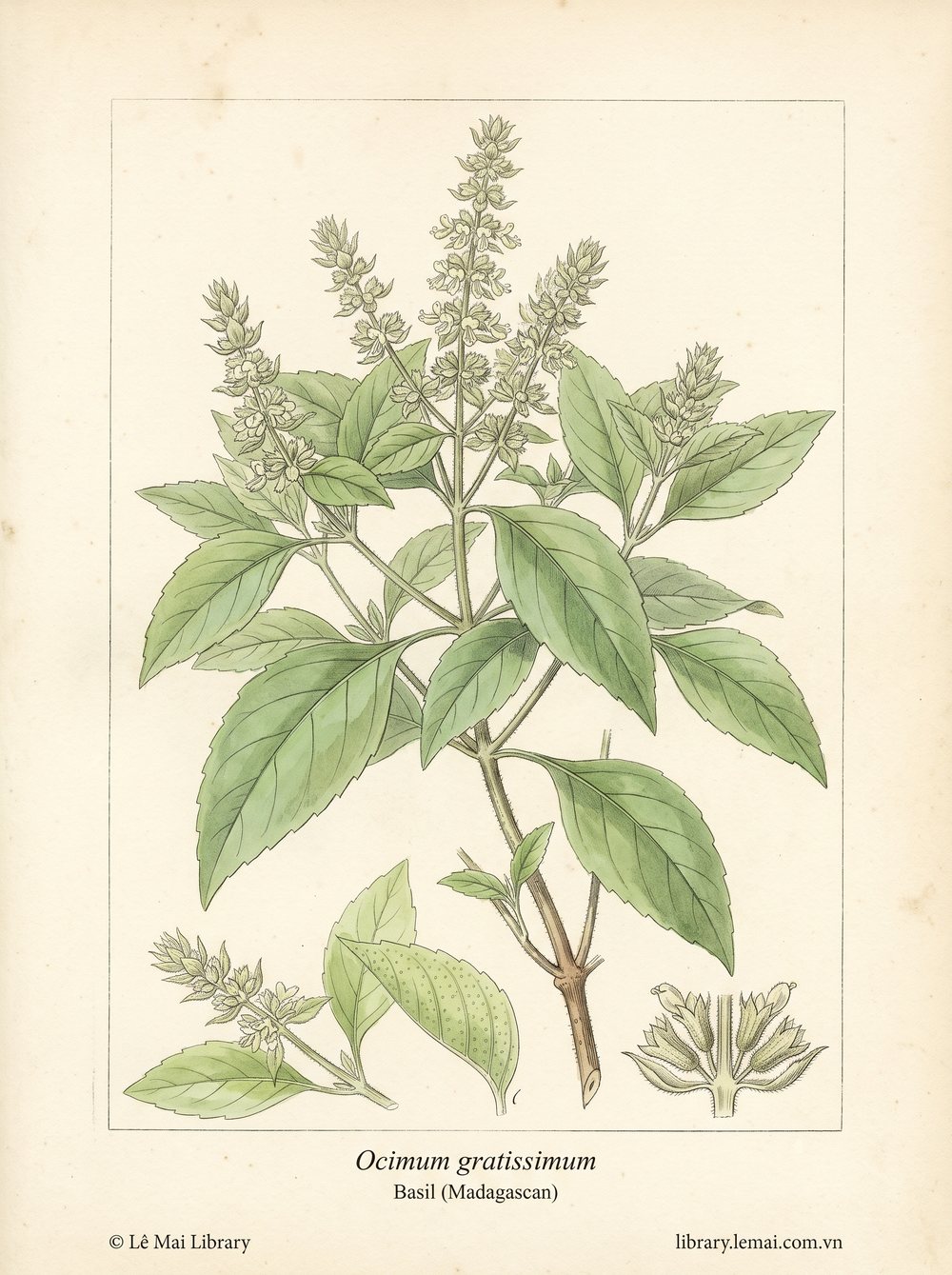
バジル マダガスカル
Húng quế Madagascar
Ocimum gratissimum
Romba, Ramy, Ocimum viride
Potentially carcinogenic due to high estragole content. May inhibit blood clotting through metabolic constituents.
Should not be taken orally.
Maximum dermal use level 0.2 percent based on 50 percent estragole and a dermal limit of 0.12 percent for estragole.
| Estragole | 45.0 – 50.0 % |
| Camphor | 24.0 – 30.0 % |
| (+)-Limonene | 2.0 – 6.0 % |
| β-Caryophyllene | 1.0 – 4.0 % |
| α-Caryophyllene | 1.0 – 4.0 % |
| Camphene | 1.0 – 3.0 % |
| (E)-β-Ocimene | 0.5 – 3.0 % |
| α-Pinene | tr, 1.0 % |
| 1,8-Cineole | tr, 1.0 % |
The estragole/camphor chemotype of Ocimum gratissimum is produced in Madagascar. The folk names romba and ramy are Malagasy.
The eugenol chemotype of the same species is pungent basil, produced in India.
Family Lamiaceae. Botanical synonym Ocimum viride.
One of the most camphor-rich basil oils. Only usable at heavy dilution.