Cinnamic acid
3-Phenyl-2-propenoic acid
β-Phenylacrylic acid · trans-Cinnamic acid
化学組成 · Constituent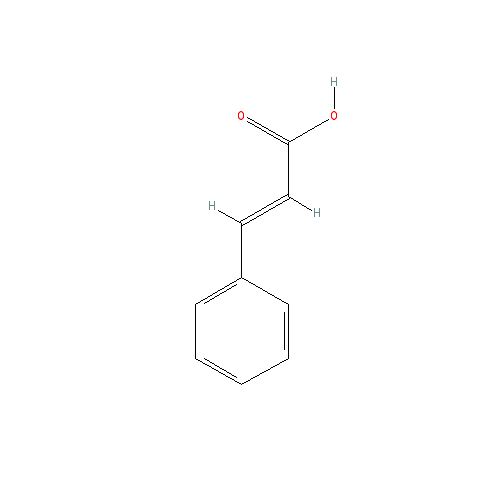
3-Phenyl-2-propenoic acid
β-Phenylacrylic acid · trans-Cinnamic acid
化学組成 · Constituent
Cinnamic acid là chất chuyển hoá tự nhiên của cinnamaldehyde và một thành phần phổ biến trong balsam.
Trên da. Patch test 4 phần trăm trên 25 tình nguyện không kích ứng và không mẫn cảm. Trong nhóm bệnh nhân đã mẫn cảm Peru balsam, 32 trong 128 (25 phần trăm) phản ứng dương với 5 phần trăm. Trong 184 bệnh nhân Nhật, không ai nhạy ở 2 phần trăm, một người nhạy ở 5 phần trăm.
Đường uống. LD50 cấp tính 2.5–5 g/kg ở chuột, chuột nhắt và chuột lang; LD50 da thỏ vượt 5 g/kg.
Sinh sản. Liều uống 5 hoặc 50 mg/kg suốt thai kỳ ở chuột không gây độc phôi. Trọng lượng, kích thước, sống sót và phát triển của con bình thường. Không gắn kết với thụ thể estrogen ở mô tử cung chuột.
Gan. Không cạn kiệt glutathione gan.
Đột biến gen. Không gây đột biến trong Ames test. Không gây đột biến trong SOS chromotest và Bacillus subtilis rec. Có hoạt tính độc gen yếu trong tế bào buồng trứng hamster Trung Quốc.
Cinnamic acid is a natural metabolite of cinnamaldehyde and a common balsam constituent.
Skin. A 4 percent patch test on 25 volunteers caused no irritation or sensitization. Among Peru balsam sensitized patients, 32 of 128 (25 percent) reacted to 5 percent. In 184 Japanese patients, none reacted at 2 percent and one at 5 percent.
Oral. Acute oral LD50 is 2.5–5 g/kg across rats, mice and guinea pigs; rabbit dermal LD50 exceeds 5 g/kg.
Reproductive. Oral 5 or 50 mg/kg throughout pregnancy in rats produced no embryotoxic effects. Pup weight, size, survival and development were normal. The compound did not bind to estrogen receptors in rat uterine tissue.
Liver. Does not deplete hepatic glutathione.
Mutagenicity. Non-mutagenic in the Ames test. Non-mutagenic in the SOS chromotest and Bacillus subtilis rec assay. Weak genotoxic activity in Chinese hamster ovary cells.
| Nhựa Peru · Peru balsam | 0 – 5.8 % |
| Bồ kết Styrax · Styrax | 4.0 – 4.8 % |
| Boronia | 1.9 – 4.3 % |
| Nhựa Tolu · Tolu balsam | 2.7 % |
| An tức hương · Benzoin | tr – 1.4 % |
| Labdanum | 0 – 1.4 % |
Cinnamic acid được sinh ra in vivo từ oxi hoá cinnamaldehyde. Phần lớn được bài tiết dưới dạng hippuric acid: chó, mèo, chuột và thỏ 39–74 phần trăm. Ở người 50–87 phần trăm hippuric acid và 1–6 phần trăm cinnamoyl glucuronide.
Ở chuột nhắt, tuỳ liều ip, 44–70 phần trăm bài tiết hippuric acid (tăng theo liều) và 2.4–28.6 phần trăm cinnamoylglycine.
Cinnamic acid is generated in vivo from oxidation of cinnamaldehyde. Most is excreted as hippuric acid: 39–74 percent in dogs, cats, rats and rabbits. In humans 50–87 percent as hippuric acid and 1–6 percent as cinnamoyl glucuronide.
In mice, depending on intraperitoneal dose, 44–70 percent is excreted as hippuric acid (rising with dose) and 2.4–28.6 percent as cinnamoylglycine.
Cinnamic acid là cấu tử cơ bản cho note balsamic và là một chất phụ trợ tự nhiên cho hương quế. Hợp chất cũng có hoạt tính ức chế monoamine oxidase rất yếu.
Cinnamic acid is a foundational constituent for balsamic notes and a natural auxiliary for cinnamon aromas. The compound also weakly inhibits monoamine oxidase.