Menthofuran
3,6-Dimethyl-4,5,6,7-tetrahydrobenzo[b]furan
3,9-Epoxy-p-mentha-3,8-diene
化学組成 · Constituent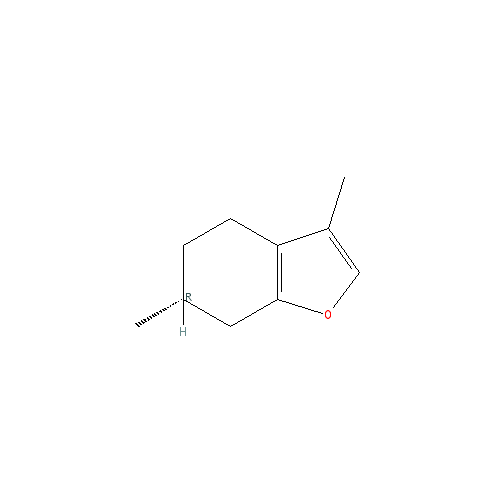
3,6-Dimethyl-4,5,6,7-tetrahydrobenzo[b]furan
3,9-Epoxy-p-mentha-3,8-diene
化学組成 · Constituent
Menthofuran is a furanoid monoterpenoid present at low levels in mint oils and palo santo. The compound is significantly hepatotoxic, approximately twice as toxic as pulegone.
Hepatotoxicity. Oral dosing at 250 mg/kg/day for 3 days in rats caused liver damage shown by changes in hepatic enzyme markers. Menthofuran destroys hepatic CYP and binds strongly to rat liver protein, three times more than to lungs and kidneys.
Metabolic activation. Menthofuran is activated via an epoxide to 8-pulegone aldehyde, a highly reactive metabolite that may be the ultimate toxicant. Low doses are protected by hepatic glutathione.
Acute toxicity. No LD50 values have been reported. Ip injection at 200 mg/kg killed 5 of 15 mice within 24 hours. The estimated mouse ip LD50 is approximately 250 mg/kg.
Safety recommendation. The proposed safe dose is half that of pulegone, equivalent to 0.2 mg/kg/day, or 14 mg per adult oral dose, or 0.5 percent dermal exposure.
| Palo santo | 6.6 – 11.8 % |
| Peppermint | tr – 9.4 % |
| Cornmint | 0.4 – 0.6 % |
Human CYP enzymes metabolize (6R)-(+)-menthofuran to 2-hydroxymenthofuran, an intermediate in the formation of mintlactone and isomintlactone. The compound is also converted via an epoxide to the highly reactive 8-pulegone aldehyde.
(R)-(+)-Menthofuran is a mechanism-based inhibitor of CYP2A6. Inhibition of this enzyme may reduce metabolic oxidation, thereby reducing production of toxic metabolites.
Menthofuran is the proximate hepatotoxic metabolite of pulegone, classed by the Council of Europe as a hepatotoxic compound. Oils high in menthofuran such as peppermint and palo santo warrant caution for oral use.