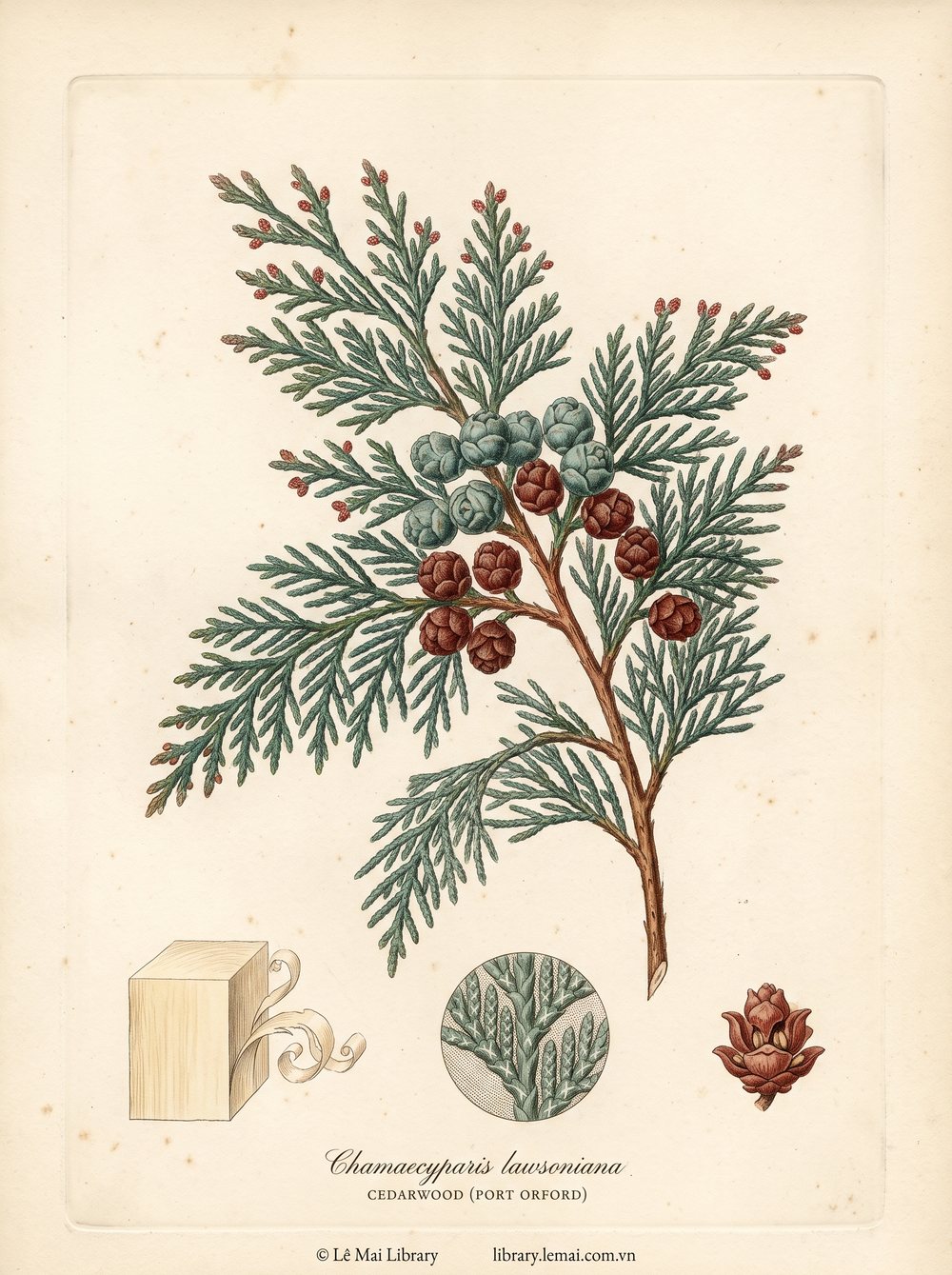
ポートオーフォードシダーウッド
Tuyết tùng Port Orford
Chamaecyparis lawsoniana
Rose of cedar, Oregon cedar
No specific contraindications in available data.
Mouse local lymph node assay: did not induce a hypersensitivity response at 0.5, 5 or 50 percent, therefore unlikely to be a sensitizer in humans.
Undiluted oil strongly irritated rabbit skin, but at 5 percent only slightly irritant.
α-Terpineol is notably non-reactive dermally.
| α-Terpineol | 14.3 % |
| δ-Cadinene | 8.2 % |
| α-Pinene | 6.5 % |
| Camphor | 5.9 % |
| α-Fenchol | 5.5 % |
| α-Cadinol | 5.3 % |
| Fenchone | 4.7 % |
| α-Muurolene | 4.2 % |
| T-Cadinol | 3.4 % |
| β-Terpineol | 3.3 % |
| (+)-Limonene | 2.7 % |
| T-Muurolol | 2.7 % |
| Citronellol | 2.3 % |
| α-Amorphene | 1.9 % |
| Terpinolene | 1.6 % |
Chamaecyparis lawsoniana is a large tree of northern California and Oregon, USA. The name 'Port Orford cedar' follows the Oregon coastal town.
Limited availability.
Family Cupressaceae. Same genus as Chinese cedarwood (Chamaecyparis funebris).
UNEP-WCMC has proposed that CITES add Chamaecyparis lawsoniana to its list of threatened plant species. Sourcing should require sustainability certification.