Fenchone
1,3,3-Trimethylbicyclo[2.2.1]heptan-2-one
1,3,3-Trimethyl-2-norbornanone · 1,3,3-Trimethyl-2-norcamphanone
化学組成 · Constituent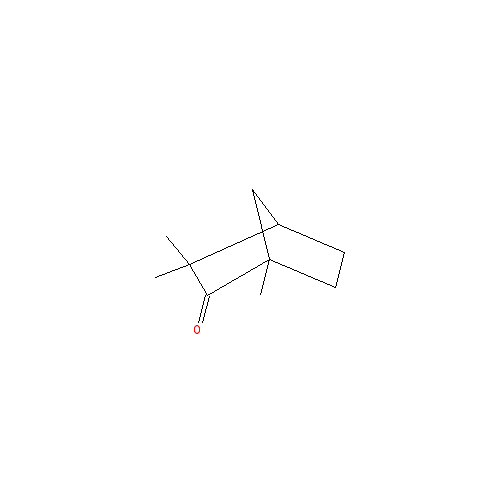
1,3,3-Trimethylbicyclo[2.2.1]heptan-2-one
1,3,3-Trimethyl-2-norbornanone · 1,3,3-Trimethyl-2-norcamphanone
化学組成 · Constituent
Fenchone is a monoterpenoid ketone occurring substantially in Spanish lavender, bitter fennel and thuja oils. Its safety profile shows the compound is relatively benign at standard use levels.
Skin. A 4 percent patch test on human subjects produced neither irritation nor sensitization.
Oral and dermal. Acute oral LD50 in rats is 6.16 g/kg. Acute dermal LD50 in rabbits exceeds 5 g/kg.
Neurology. Subcutaneous injection at 1,133 mg/kg in mice produced convulsions, but not at 500 mg/kg. In a 16-day oral study in dogs, it was convulsant and lethal at 1,400 mg/kg/day, produced transient tremors at 750 mg/kg/day, and had no apparent effects at 210 to 420 mg/kg/day. The very high doses are not representative of therapeutic use.
Mutagenicity. Not mutagenic in Salmonella strains TA97, TA98, TA100 or TA1535. Not genotoxic in rat bone marrow micronucleus tests.
| Lavender (Spanish) | 14.9 – 49.1 % |
| Fennel (bitter) | 4.0 – 24.0 % |
| Thuja | 12.2 – 12.8 % |
| Fennel (sweet) | 0.2 – 8.0 % |
| Cedarwood (Port Orford) | 4.7 % |
| Labdanum | 1.4 – 2.3 % |
| Pine (Scots) | 0 – 2.1 % |
| Sage (African wild) | 1.4 % |
| Cistus | 0 – 1.1 % |
In both dogs and rabbits, fenchone is metabolized by hydroxylation. 4-Hydroxyfenchone and 5-hydroxyfenchone appear in dog urine, while 8-, 9- and 10-hydroxyfenchone appear in rabbit urine.
The French regulation on fenchone in absinthe dates from 1915, a legislative response to what was perceived as absinthe toxicity at the time. It is not based on modern toxicological data.