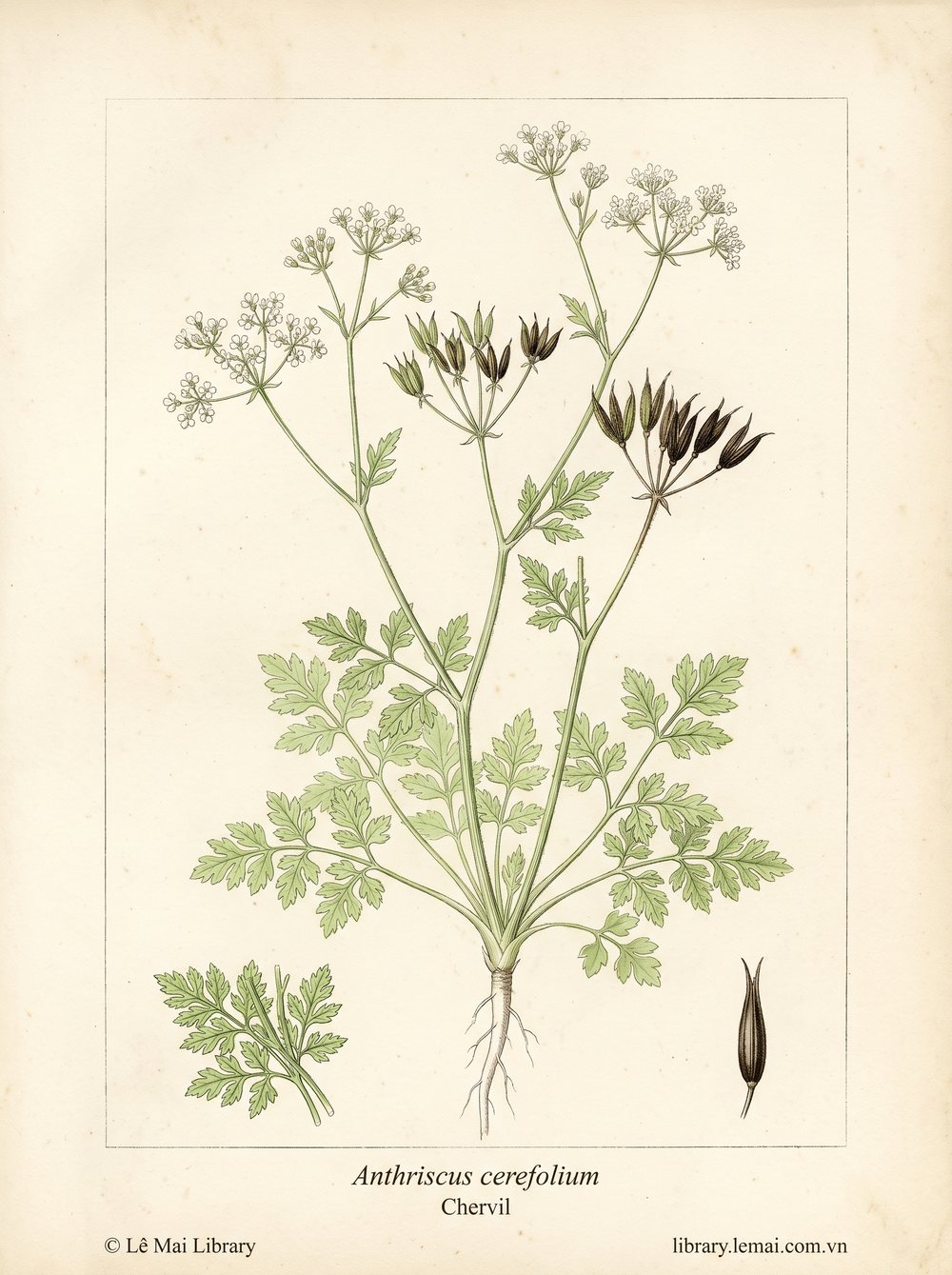
チャービル
Ngò Pháp, Cần tây Pháp
Anthriscus cerefolium
Potentially carcinogenic due to high estragole content. May inhibit blood clotting.
Should not be taken orally.
Maximum dermal use level 0.15 percent based on 81.3 percent estragole and a dermal limit of 0.12 percent.
Estragole inhibits platelet aggregation, may interfere with blood clotting.
| Estragole | 49.9 – 81.3 % |
| 1-Allyl 2,4-dimethoxybenzene | 13.4 – 31.9 % |
| Nonanal | 0.1 – 3.9 % |
| 1-Allyl 3,4-dimethoxybenzene | 0.6 – 1.4 % |
| Undecane | 0.8 – 1.3 % |
| 1-Octadecanol | 0 – 1.3 % |
Anthriscus cerefolium is an annual herb of western and central Asia, cultivated in Europe for over 2000 years. The leaves are a traditional spice in French cuisine.
The oil is steam-distilled from the leaves. Production is very limited.
Family Apiaceae. Same family as cumin, anise, coriander, dill, a family with many estragole-rich species.
Fresh chervil (the spice) contains very little estragole compared with the concentrated essential oil, the traditional culinary use is safe.