Thujone
1-(1-Methylethyl)-4-methylbicyclo[3.1.0]hexan-3-one
Thujan-3-one · Absinthone · 3-Sabinone · α-Thujone · β-Thujone
化学組成 · Constituent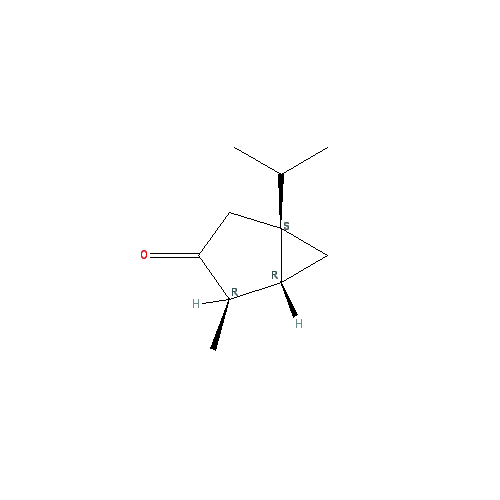
1-(1-Methylethyl)-4-methylbicyclo[3.1.0]hexan-3-one
Thujan-3-one · Absinthone · 3-Sabinone · α-Thujone · β-Thujone
化学組成 · Constituent
Thujone comprises α and β isomers always found together in nature, in proportions that vary greatly between oils. α-Thujone is about 5 times more toxic than β-thujone by subcutaneous route. The compound is a non-competitive GABA receptor antagonist, causing convulsions and neurotoxicity.
Skin. At 4 percent on volunteers α-thujone was neither irritating nor sensitizing. Dermal absorption is around 2 to 5 percent.
Oral. Acute oral LD50 in rats was 190 to 500 mg/kg. Acute intraperitoneal LD50 was 1,250 mg/kg. Oral dosing at 250 mg/kg caused convulsions and death in mice.
Nervous system. Convulsions have been reported in humans after ingestion of thujone-rich oils. The lowest convulsant dose was 12 drops of Dalmatian sage, equivalent to 150 to 200 mg of thujone or 2.2 to 2.9 mg/kg. Taking 20 drops of thuja oil twice daily for 5 days caused a tonic seizure and skull fracture in one case. Rats metabolize thujone about 10 times faster than humans, so humans may be 10 times more susceptible to thujone neurotoxicity.
Mechanism. Thujone non-competitively antagonizes GABA-A, blocking chloride channels and causing neuronal hyperexcitation. The compound crosses the blood-brain barrier.
Subchronic 14 weeks. Convulsion NOAEL was 10 mg/kg in male rats and 5 mg/kg in females.
Chronic 2 years. Rats given 12.5, 25 or 50 mg/kg/day of mixed thujone. High doses caused early mortality. Increased preputial gland carcinoma in male rats, but not dose-dependent. No carcinogenicity evidence in female rats or mice.
Mutagenicity. Not mutagenic in Salmonella or E. coli, with or without S9. Slightly genotoxic in a micronucleus test in female mice.
| Western red cedar | 63.5 – 84.0 % α / 4.9 – 15.2 % β |
| Genipi | 79.8 % α / 10.4 % β |
| Wormwood (sea) | 63.3 % α |
| Thuja | 48.7 – 51.5 % α / 7.9 – 9.9 % β |
| Sage (Dalmatian) | 13.1 – 48.5 % α / 3.9 – 19.1 % β |
| Wormwood (white) | 25.7 – 36.8 % α / 2.0 – 9.0 % β |
| Wormwood | 2.3 – 3.4 % α / 33.1 – 59.9 % β |
| Tansy | 1.1 % α / 45.2 % β |
| Mugwort (great) | 34.0 % β |
| Lanyana | 22.5 % α / 8.9 % β |
| Boldo | 14.3 % α / 7.2 % β |
| Mugwort (common, camphor/thujone CT) | 11.4 % α |
| Artemisia vestita | 1.8 % α / 0.7 % β |
| Tansy (blue) | 0 – 0.2 % |
| Sage (Greek) | 1.6 % β |
α- and β-Thujone are both rapidly detoxified through CYP-dependent oxidative metabolism. In rabbits, thujone is hydroxylated to 4-p-menthanol-2-one and excreted in urine as a glucuronide. In mice, α-thujone is metabolized to 7-hydroxy-α-thujone as the major product.
In humans, α-thujone is mainly metabolized to 4- and 7-hydroxythujone by CYP2A6. α-Thujone inhibits CYP2A6 with an IC50 of 15.4 µM and CYP2B6 with an IC50 of 17.5 µM, so it can prolong and augment its own toxicity.
The folklore tying absinthe toxicity to thujone is largely unsupported. Historical absinthes contained low thujone levels of 0 to 4.3 mg/L. Absinthism syndrome reflects long-term consumption of high-strength alcohol with multiple plant constituents.
At high doses, thujone reduces attention and increases anxiety. It does not produce THC-like activity as once hypothesized.