Chamazulene
1,4-Dimethyl-7-ethylbicyclo[0.3.5]deca-1,3,5,7,9-pentaene
Dimethulene · 1,4-Dimethyl-7-ethylazulene
化学組成 · Constituent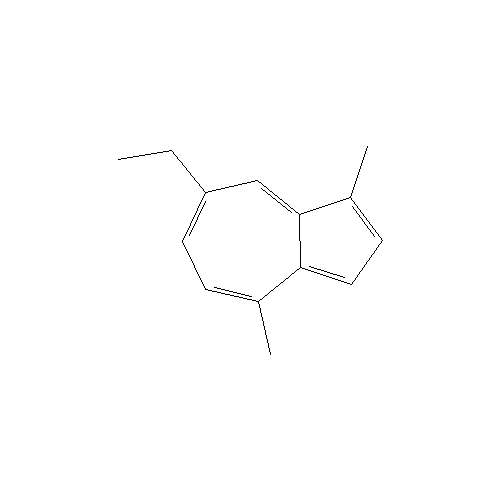
1,4-Dimethyl-7-ethylbicyclo[0.3.5]deca-1,3,5,7,9-pentaene
Dimethulene · 1,4-Dimethyl-7-ethylazulene
化学組成 · Constituent
Chamazulene is the deep blue chromophore of German chamomile and yarrow. The compound is not present in the plant itself but forms during distillation from matricin as a precursor.
Antioxidant activity. Chamazulene is a strong antioxidant. IC50 for lipid peroxidation inhibition is 18 μM (3.31 μg/mL) after 45 minutes. It inhibits deoxyribose degradation and non-enzymatic lipid peroxidation with very low IC50 values.
Direct toxicity data are very limited.
| Tansy (blue) | 17.0 – 38.3 % |
| Chamomile (German) | 3.4 – 23.4 % |
| Mugwort (great) | 22.4 % |
| Yarrow (chamazulene CT) | 19.7 % |
| Cypress (blue) | 5.6 % |
| Chamomile (Roman) | 0 – 4.4 % |
| Pine (Scots) | 0 – 1.7 % |
Chamazulene gives the unique deep blue color to blue chamomile and blue tansy. The compound is sensitive to light and heat; oils lose color on prolonged exposure.
The anti-inflammatory skin activity of German chamomile is largely attributed to chamazulene and α-bisabolol.