モロッカンカモミール
Cúc Morocco
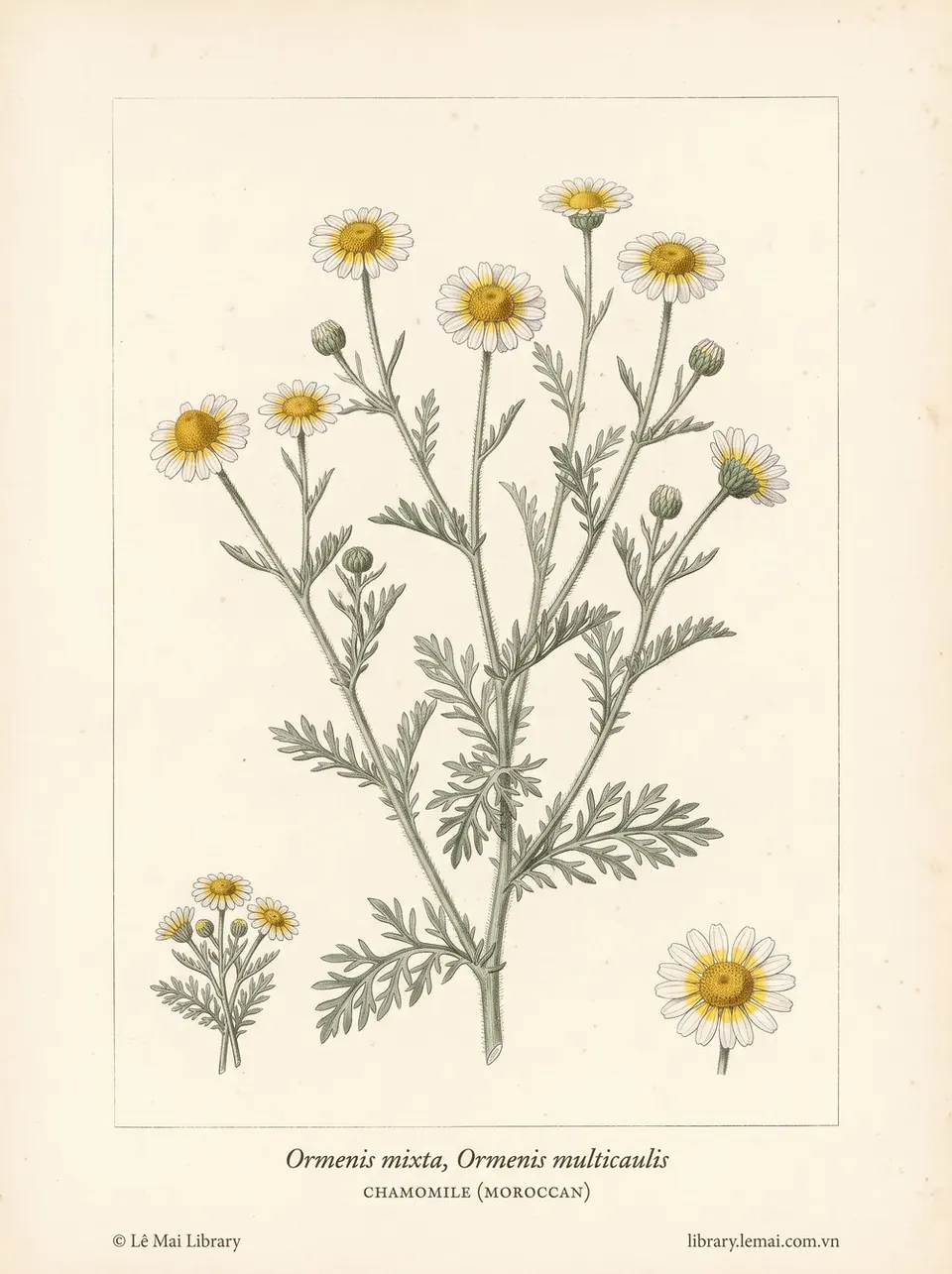
Ormenis mixta, Ormenis multicaulis
Wild chamomile
Moroccan chamomile essential oil is steam-distilled from the flowering aerial parts of Ormenis mixta and Ormenis multicaulis, North African perennials in the daisy family; despite the name, they belong to a different genus from German and Roman chamomile. Its main components are santolina alcohol (32%) and α-pinene (15%). Reconstructed oils are common, so check the certificate of analysis.
Updated 6 Nov 2026 · Lê Mai Team
No specific contraindications in available data.
No information on dermal reactions or acute toxicity for Moroccan chamomile.
Commercial reconstructions are common, read the certificate of analysis carefully.
| Santolina alcohol | 32.0 % |
| α-Pinene | 15.0 % |
| Germacrene | 5.0 % |
| (E)-Pinocarveol | 3.0 % |
| Bisabolene | 2.5 % |
| Yomogi alcohol | 2.4 % |
| Artemisia alcohol | 2.3 % |
| Bornyl acetate | 2.2 % |
| β-Caryophyllene | 1.5 % |
| Bornyl butyrate | 1.3 % |
| Borneol | 1.0 % |
| β-Myrcene | 1.0 % |
Ormenis mixta and Ormenis multicaulis are perennial herbs of North Africa, particularly Morocco. Despite the 'chamomile' name, they are in a different genus from German and Roman chamomile.
Family Asteraceae. Compositional data for Ormenis multicaulis is unreliable due to limited research.
Produced mainly in Morocco.
The 'chamomile' name here is commercial, not reflecting close botanical relationship. The aroma also differs markedly from German or Roman chamomile.