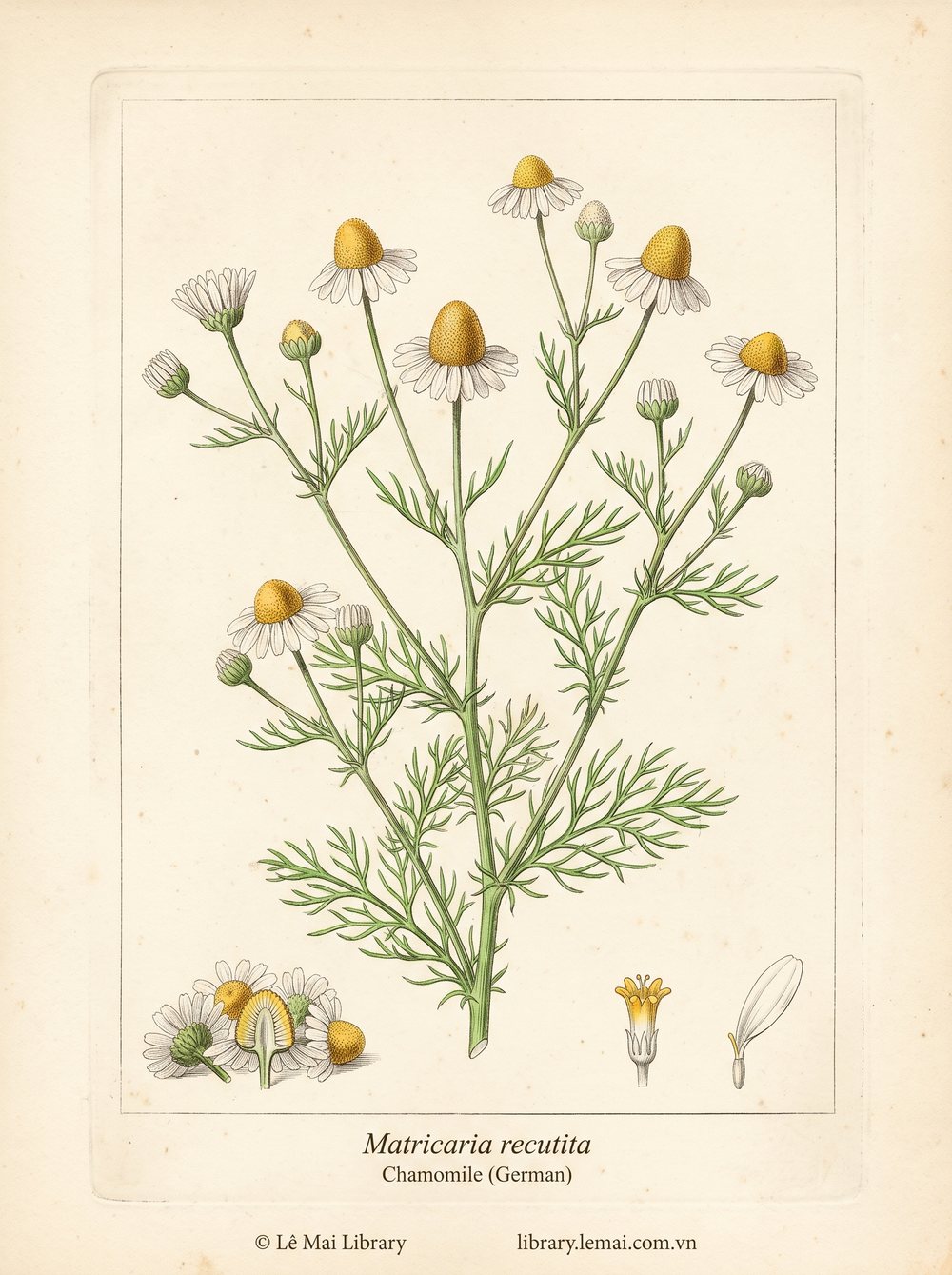
ジャーマンカモミール
Cúc Đức, Cúc Đại bi
Matricaria recutita
Blue chamomile, Hungarian chamomile, Sweet false chamomile, Chamomilla recutita, Matricaria chamomilla
Theoretical drug interaction via liver enzymes.
Oral caution: drugs metabolized by CYP2D6 (all chemotypes), CYP1A2, CYP2C9, CYP3A4 (α-bisabolol/farnesene chemotype).
GRAS status. No irritation or sensitization at tested levels. Non-phototoxic.
α-Bisabolol was not teratogenic in rats at 1 mL per kg. High-α-bisabolol chamomile oils are likely not hazardous in pregnancy.
In vitro research: blue chamomile oil inhibits prostate, lung and breast cancer cells with IC50 0.07 percent. Significant antimutagenic activity.
| α-Bisabolol oxide A | 0 – 57.7 % (chemotype-dependent) |
| α-Bisabolol | 0 – 60.1 % (chemotype-dependent) |
| (E)-β-Farnesene | 0 – 43.8 % (chemotype-dependent) |
| Chamazulene | 2.7 – 23.4 % (variable) |
| α-Bisabolol oxide B | 0 – 13.5 % |
| α-Bisabolone oxide | 0 – 12.0 % |
| (Z) & (E)-Spiroethers | 5.9 – 7.0 % |
| Germacrene D | 0 – 1.6 % |
Matricaria recutita is an annual herb of central and eastern Europe. Small white-petaled flowers around a yellow center. The oil's characteristic blue color comes from chamazulene.
Family Asteraceae. Multiple chemotypes exist, produced across many countries (Germany, Hungary, Bulgaria, Brazil, Finland, Egypt), with markedly different chemistry by origin. The α-bisabolol-rich chemotype is generally preferred for therapy.
Distinct from Chamomile Roman (Chamaemelum nobile) in both species and chemistry. German is sesquiterpene-rich, Roman is ester-rich.
Prone to oxidation. Store in light-tight, cold conditions. May be adulterated with synthetic/natural mixtures containing bisabolol and azulenes.