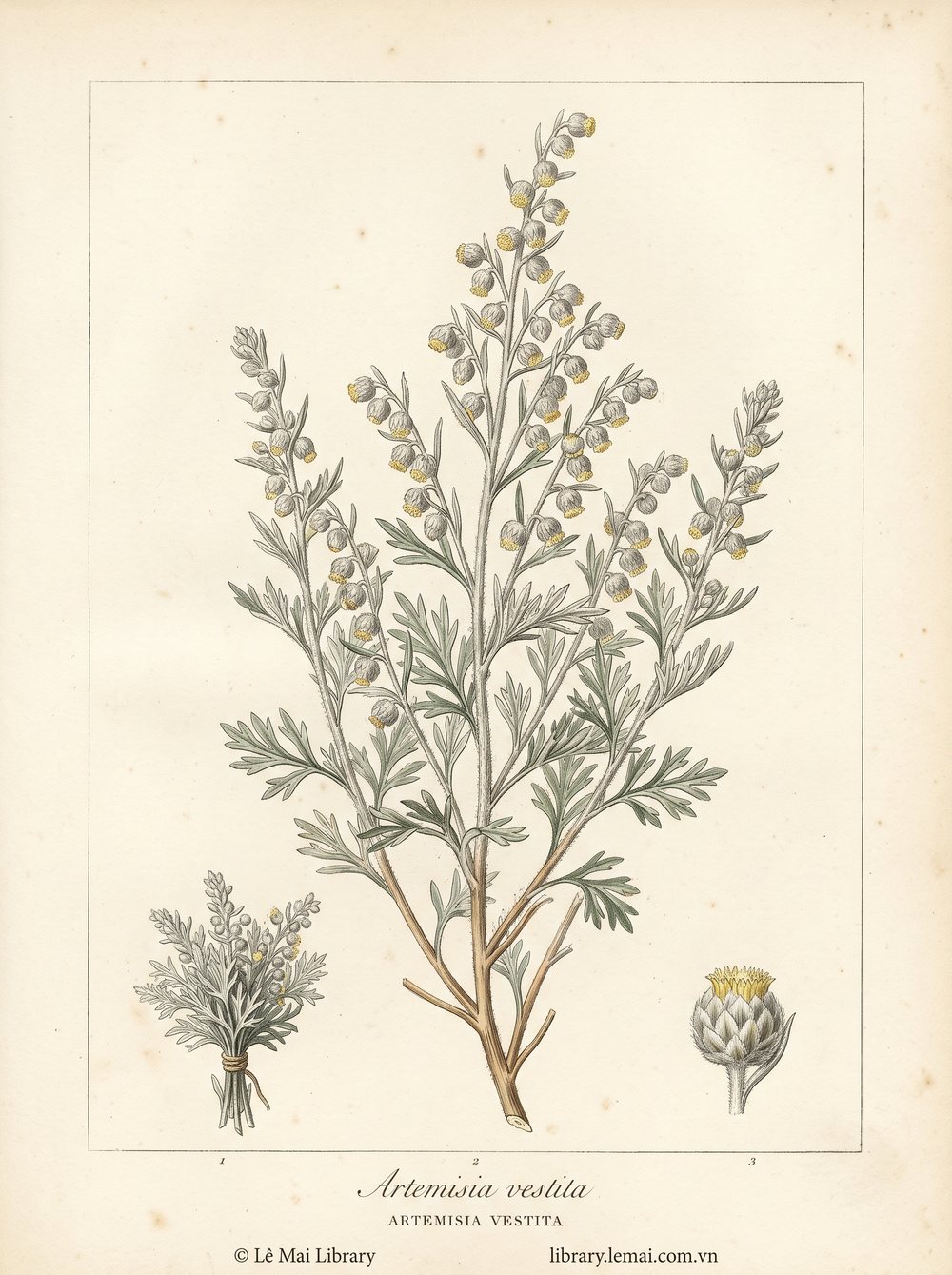
アルテミシア・ベスティタ
Ngải Vestita
Artemisia vestita
Slight neurotoxicity — due to thujone content.
Contraindicated all routes: pregnancy and breastfeeding.
High doses of thujone can cause convulsions. Thujone NOAEL for convulsions: 10 mg/kg in male rats, 5 mg/kg in females.
Both α- and β-thujone are moderately toxic, oral LD50 ranging 19-500 mg/kg across species.
Contains no known carcinogens.
| β-Himachalene | 10.1 % |
| (E)-γ-Atlantone | 6.8 % |
| 1,8-Cineole | 5.3 % |
| Himachalol | 5.0 % |
| Artemisia alcohol | 4.5 % |
| α-Himachalene | 3.5 % |
| Santolina alcohol | 3.1 % |
| allo-Himachalol | 3.0 % |
| Artemisyl acetate | 3.0 % |
| Santolinyl acetate | 2.9 % |
| α-Thujone | 1.8 % |
| β-Thujone | 0.7 % |
Plant in the Asteraceae family, native to India and the Himalayas.
Oil extracted from aerial parts (leaves, flowers, stems).
Limited production in India.
EU SCF report on thujone concluded available data was inadequate to establish TDI/ADI (Tolerable / Acceptable Daily Intake).
Limited availability.