Aromadendrene
[1aR-(1aα,4aα,7α,7aβ,7bα)]-Decahydro-1,1,7-trimethyl-4-methylene-1H-cycloprop[e]azulene
Ledene (1(10)-isomer) · Viridiflorene
化学組成 · Constituent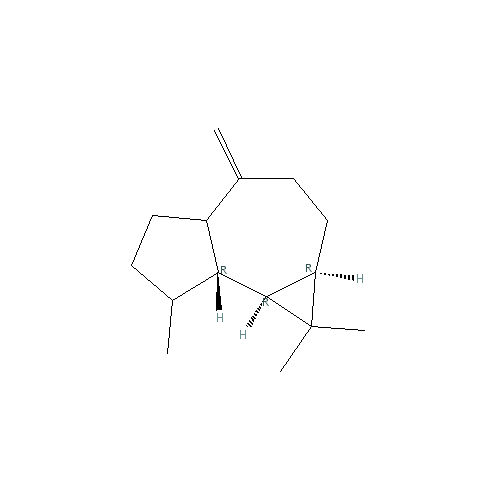
[1aR-(1aα,4aα,7α,7aβ,7bα)]-Decahydro-1,1,7-trimethyl-4-methylene-1H-cycloprop[e]azulene
Ledene (1(10)-isomer) · Viridiflorene
化学組成 · Constituent
Aromadendrene exists in multiple isomeric forms; the 1(10), (R) and (S)-allo isomers all appear in commercial essential oils.
Skin. In a group of seven dermatitis patients already sensitive to tea tree, five reacted to 1 percent aromadendrene. In a separate group of 11 tea tree sensitive patients, 5 percent aromadendrene caused no sensitization.
Genotoxicity. Non-mutagenic in the Ames test with and without S9.
The molecular structure does not present specific safety flags. Data are sparse but no significant concern is indicated.
| Gurjun balsam | 4.0 – 6.0 % |
| Patchouli | 0 – 5.0 % |
| Cubeb | 1.7 – 4.2 % |
| Rosalina | 1.5 – 4.0 % |
| Cardamon (black) | 3.2 % |
| Pteronia | 3.1 % |
| Arina | 3.0 % |
| Tea tree | tr – 3.0 % |
| Rose (Japanese) | 2.5 % |
| Phoebe | 2.4 – 2.6 % |
| Valerian (European) | 0.7 – 2.6 % |
| Manuka | 1.6 – 2.2 % |
| Eucalyptus (globulus) | 0.1 – 2.2 % |
| Rambiazana | 2.0 % |
| Vassoura | 1.6 % |
| Eucalyptus (camaldulensis) | 0.6 – 1.4 % |
| Cangerana | 1.1 % |
| Copaiba | 0 – 1.8 % |
| Fern (sweet) | 1.7 % |
| Katrafay | 0.2 – 1.0 % |
Aromadendrene is a tricyclic sesquiterpene common in the Myrtaceae family. The compound contributes warm woody notes in eucalyptus and tea tree oils.
The (S)-allo-aromadendrene isomer predominates in several pepper and oil-tree species.