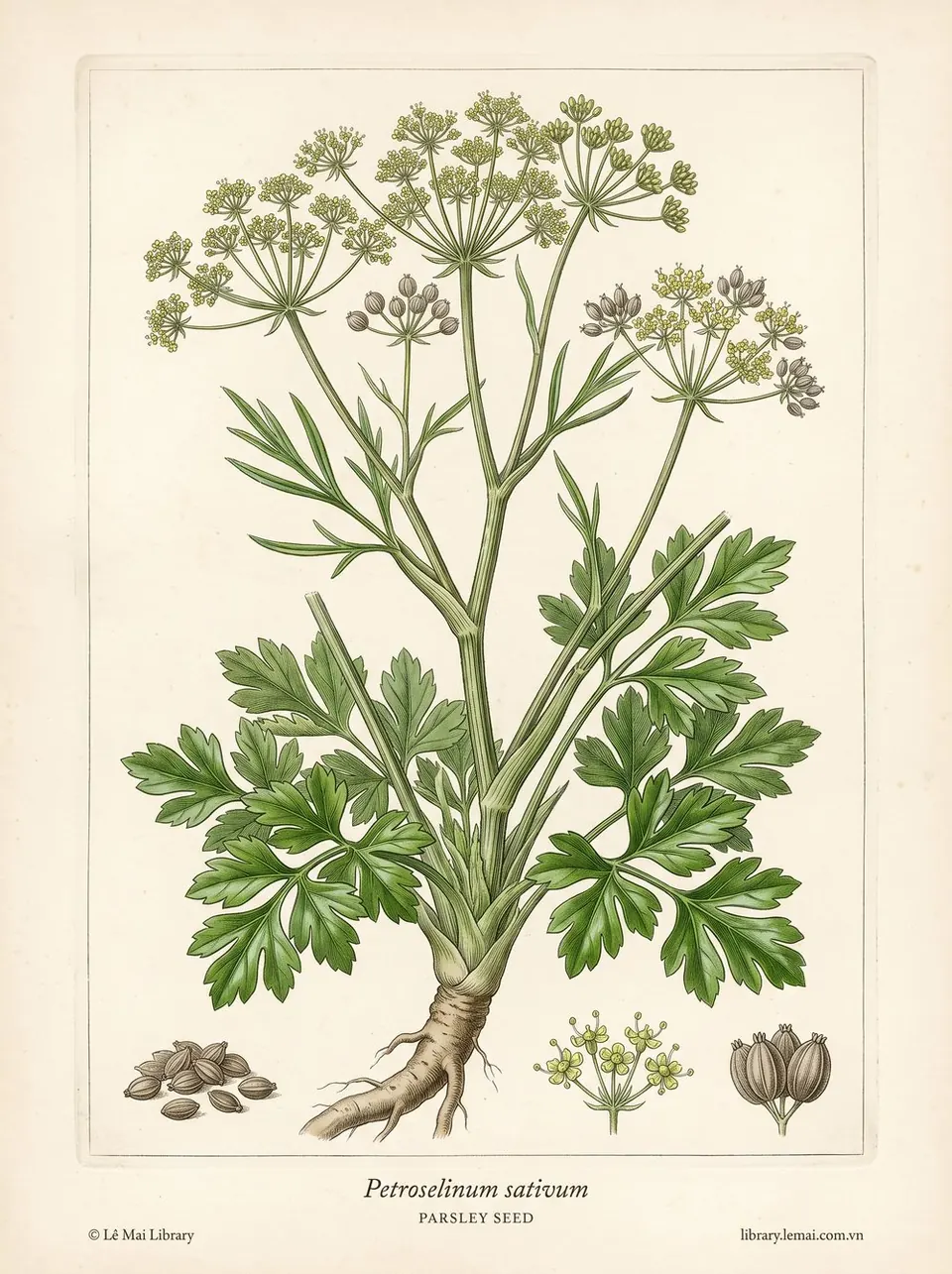
パセリシード
Ngò tây (hạt)
Petroselinum sativum
Parsley seed essential oil is steam-distilled from the seeds of Petroselinum sativum, a member of the carrot family, harvested after the plant flowers and sets seed. Its chemistry differs sharply from the leaf oil: apiole can reach 80%, along with myristicin. It is strictly contraindicated in pregnancy and breastfeeding by all routes, must never be taken orally, and is best avoided in everyday cosmetics.
Updated 4 Nov 2026 · Lê Mai Team
Apiole can reach 80 percent. Apiole is a strong uterine stimulant, causing miscarriage when used orally at high doses. Multiple historical fatalities from using parsley seed oil as an abortifacient.
STRICTLY CONTRAINDICATED in pregnancy and breastfeeding, by all routes.
Avoid oral use. Dermal dose must be very low.
Drug interactions through multiple enzymes. Use orally with caution.
| Apiole | 60.0 – 80.0 % |
| Myristicin | 5.0 – 18.0 % |
| Tetramethoxyallylbenzene | 3.0 – 8.0 % |
| Allylbenzene | 1.0 – 5.0 % |
Parsley seeds are harvested after the plant flowers and sets seed. Chemistry differs markedly from the leaf, apiole far higher.
Family Apiaceae.
In classical herbal medicine, parsley seed was used as an abortifacient, a dangerous and potentially fatal use.
The essential oil should be avoided in mainstream cosmetics.