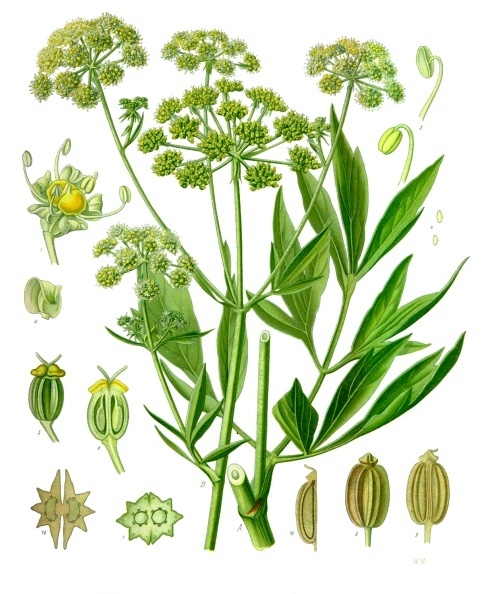
ラベジリーフ
Cần tây Tây, Lovage (lá)
Levisticum officinale
Phthalide compounds (butylidenephthalide, validene) make up a significant portion. Mild skin sensitization risk.
Not recommended in pregnancy and breastfeeding due to lack of data.
Store properly.
| α-Terpinyl acetate | 5.0 – 15.0 % |
| (Z)-β-Ocimene | 8.0 – 12.0 % |
| β-Phellandrene | 5.0 – 10.0 % |
| (Z)-3-Butylidenephthalide | 3.0 – 8.0 % |
| α-Pinene | 2.0 – 5.0 % |
| Pentylcyclohexadiene | 1.0 – 4.0 % |
Levisticum officinale is a perennial herb from southern Europe. Grows up to 2m tall, with compound leaves and a celery-like aroma.
The essential oil is distilled from fresh leaves. Small-scale production, mainly Eastern Europe.
Family Apiaceae (Umbelliferae), same family as celery, parsley, and anise.
Traditionally used as a culinary herb and digestive remedy.
Lovage leaf oil differs from lovage root oil (higher phthalide chemistry) and lovage seed oil, each plant part yields a distinct profile.