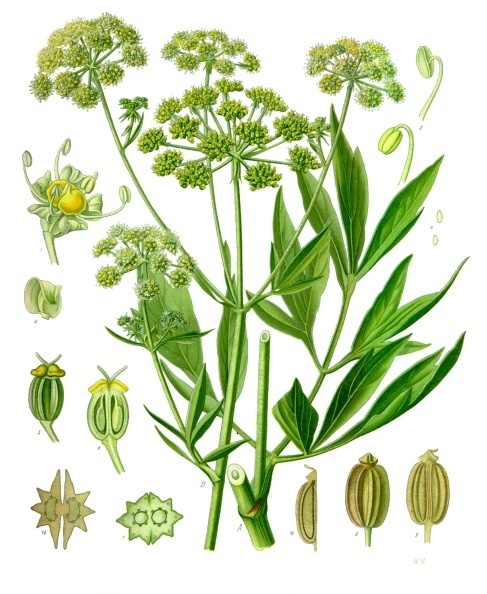
ラベジルート
Lovage (rễ)
Levisticum officinale
Phthalides comprise up to 70 percent. May be phototoxic due to furocoumarins.
Contraindicated in pregnancy and breastfeeding.
Avoid eyes and mucous membranes.
Strict dermal concentration limit required.
| (Z)-3-Butylidenephthalide | 30.0 – 50.0 % |
| (Z)-3-n-Validene-3,4-dihydrophthalide | 15.0 – 30.0 % |
| α-Terpinyl acetate | 5.0 – 10.0 % |
| α-Pinene | 2.0 – 5.0 % |
| β-Phellandrene | 1.0 – 3.0 % |
| Safrole + p-cymen-8-ol | 0 – 0.7 % |
Levisticum officinale root has a characteristically high phthalide content, chemistry quite different from the leaf.
Aroma close to celery root. Used in perfumery for animalic and tobacco-like notes.
Small-scale production, mainly Eastern Europe (Bulgaria, Romania).
Lovage root is regarded as the highest-quality lovage oil for perfumery. Strong, persistent aroma.
Caution with safrole, though present in trace amounts, it remains a suspected carcinogen.