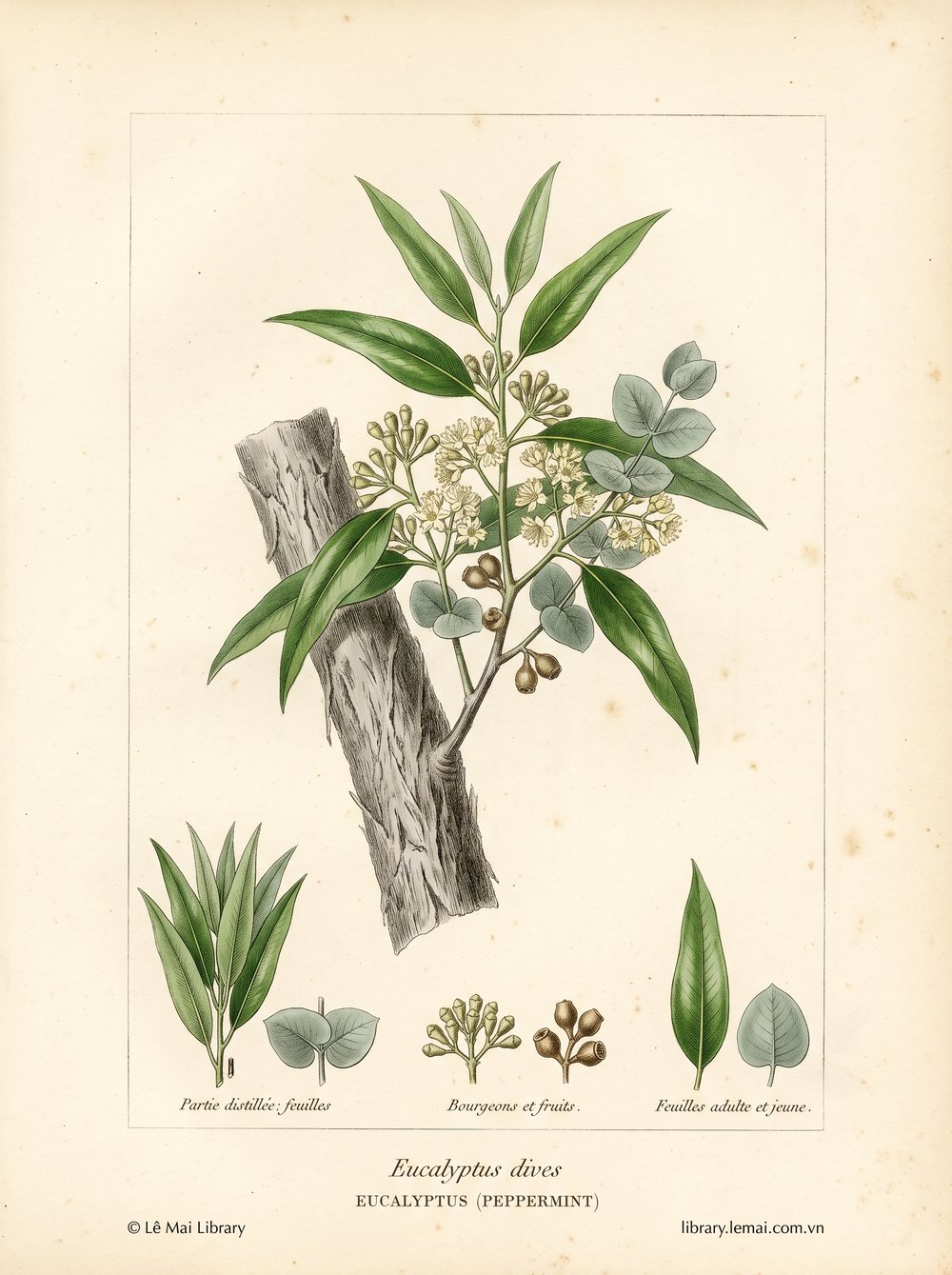
ユーカリ ペパーミント
Bạch đàn bạc hà
Eucalyptus dives
Broad-leaved peppermint, Blue peppermint, Peppermint gum
No specific contraindications in available data.
No information on dermal reactions. Piperitone (the major constituent at 54.5 percent) has rat oral LD50 of 3.55 g per kg, low toxicity.
Contains no known carcinogens. Piperitone is non-mutagenic in the Ames test.
This is the piperitone chemotype of Eucalyptus dives, distinct from cineole-rich eucalyptus oils, with no CNS risk in young children.
| Piperitone | 54.5 % |
| α-Phellandrene | 16.9 % |
| p-Cymene | 6.1 % |
| Terpinen-4-ol | 4.2 % |
| α-Pinene | 2.8 % |
| Terpinolene | 1.9 % |
| β-Myrcene | 1.4 % |
| α-Terpineol | 1.3 % |
| 1,8-Cineole | 1.2 % |
| (E)-p-Menth-2-en-1-ol | 1.2 % |
Eucalyptus dives is a tree of southeastern Australia. The name 'peppermint gum' reflects the piperitone aroma reminiscent of mint, although unrelated to Mentha botanically.
Produced in southeastern Australia. Small quantities of a 1,8-cineole chemotype of this species are also produced.
Family Myrtaceae.
Piperitone was once used to produce synthetic menthol and thymol, now superseded by cheaper chemical processes.