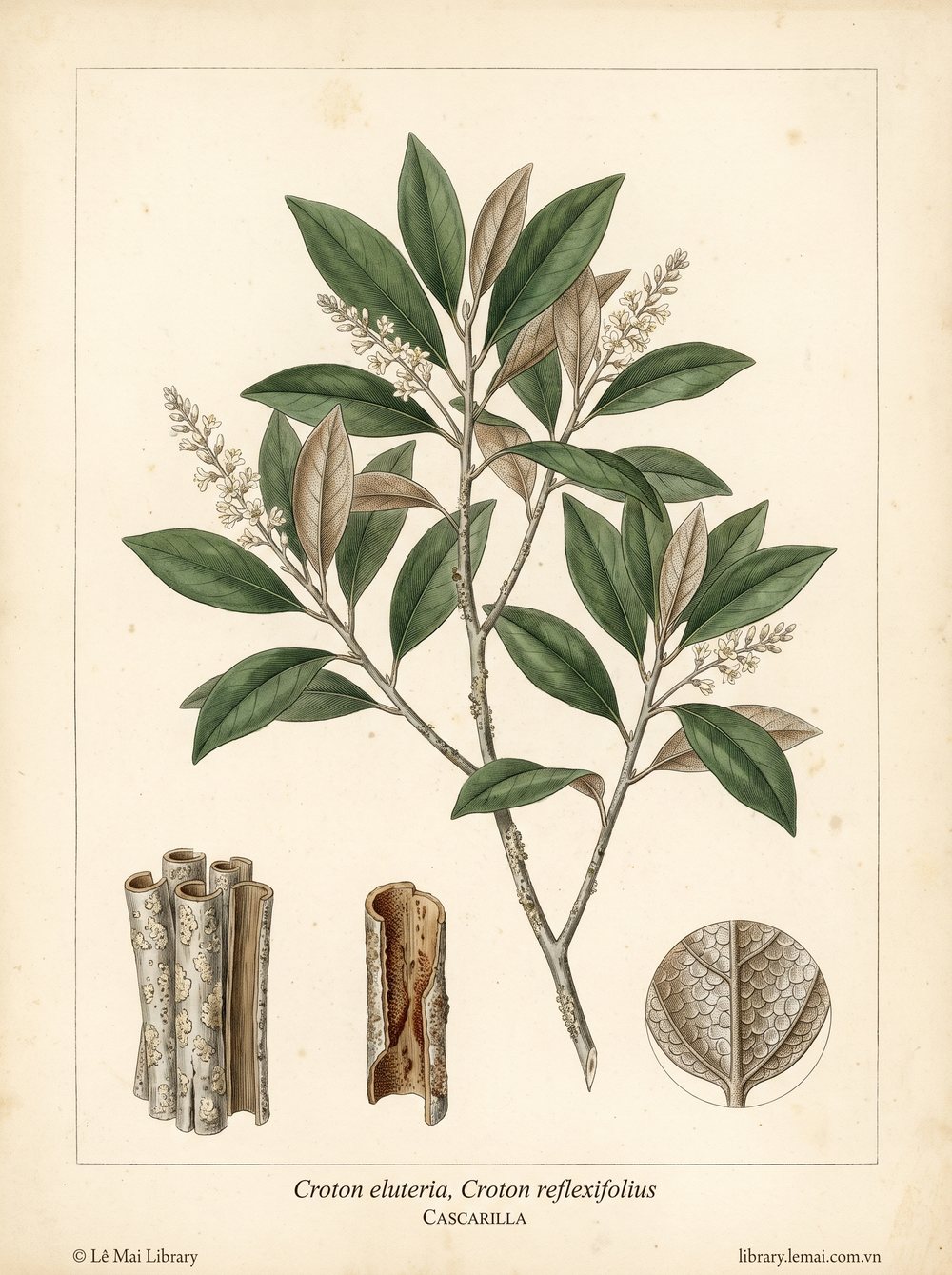
カスカリラ
Cascarilla
Croton eluteria, Croton reflexifolius
Sweet-wood
May contain methyleugenol at low levels.
Maximum adult oral dose 350 mg daily (for Bahamian cascarilla). Maximum dermal use level 10 percent.
Basis: 0.2 percent methyleugenol, with dermal limit 0.02 percent and oral 0.01 mg per kg per day.
No skin irritation or sensitization at tested levels. Non-phototoxic.
| p-Cymene | 10.0 – 18.0 % |
| Cascarilladiene | 4.6 – 6.0 % |
| Linalool | 1.9 – 5.1 % |
| α-Pinene | 2.6 – 4.6 % |
| Cuparene | 0.9 – 3.8 % |
| (+)-Limonene + 1,8-Cineole | 0.9 – 3.6 % |
| α-Thujene | 2.1 – 3.5 % |
| β-Myrcene | 0.7 – 3.4 % |
| β-Eudesmol | < 3.0 % |
| β-Selinene | 0.6 – 2.4 % |
| β-Elemene | 1.6 – 2.0 % |
| Methyleugenol | 0 – 0.2 % |
Cascarilla has two commercial sources: Croton eluteria from the Bahamas and Croton reflexifolius from El Salvador. The two oils have distinct constituent profiles, with toxicity data established mainly on the Bahamian oil.
The oil is distilled from the bark. Family Euphorbiaceae.
Traditionally used in bitters production, perfumery and certain pharmaceutical applications.
The El Salvadorian oil has only become available recently, with toxicity data established using the Bahamian oil.