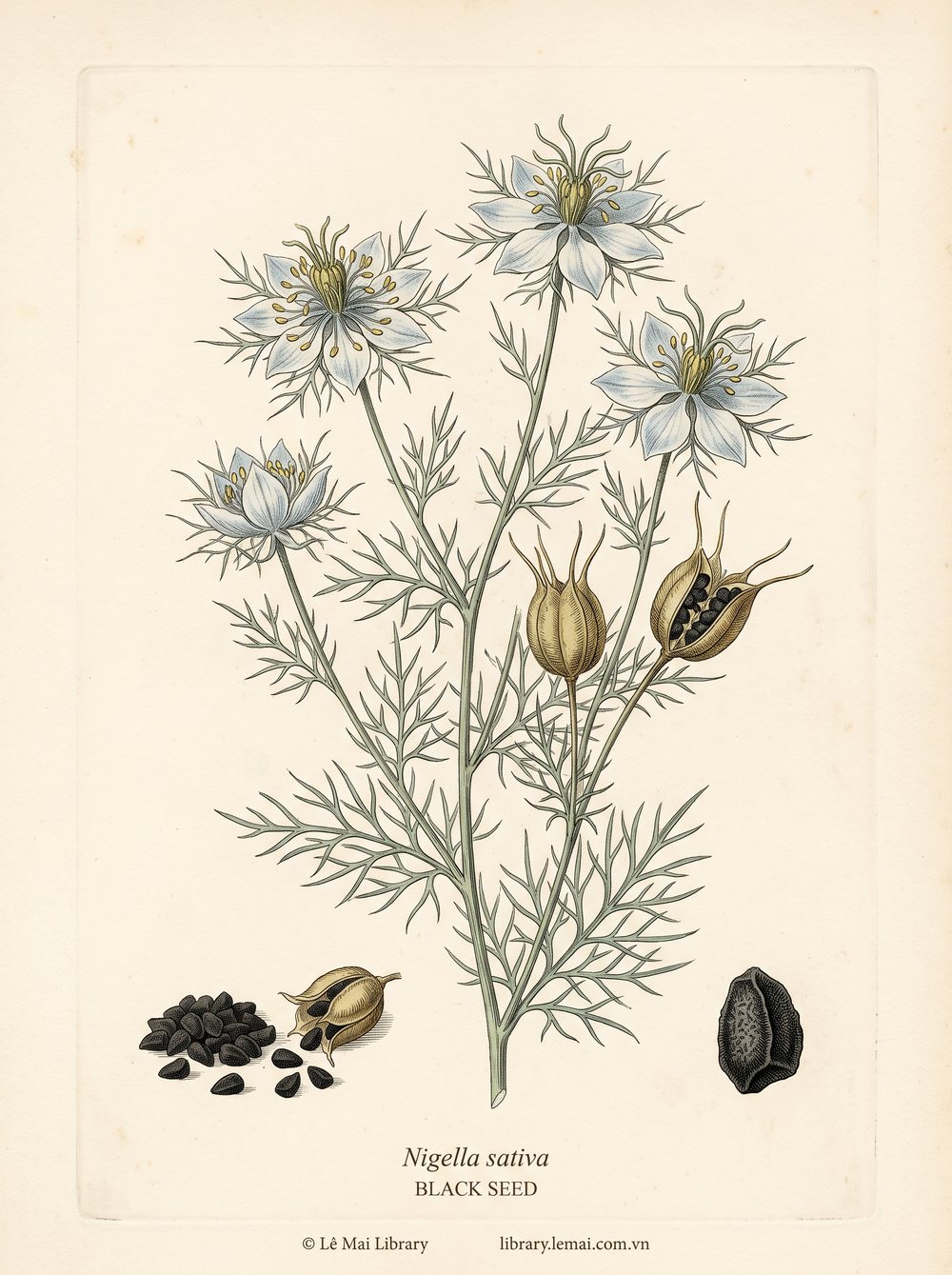
ブラックシード
Hạt đen, Hắc tô, Nigella
Nigella sativa
Black cumin, Black caraway, Roman coriander, Fennel flower, Nutmeg flower
Drug interactions. Fetotoxic based on thymoquinone content. Moderate risk of skin sensitization.
Broad contraindications: pregnancy, breastfeeding.
Oral: caution with diabetes medication.
Dermal: avoid on hypersensitive, diseased or damaged skin, and on children under 2 years.
Thymoquinone is a relatively potent contact allergen. Multiple cases of contact dermatitis from topical black seed oil have been recorded.
| Thymoquinone | 26.8 – 54.8 % |
| p-Cymene | 14.7 – 38.0 % |
| Longifolene | 1.2 – 10.2 % |
| α-Thujene | 1.3 – 10.1 % |
| Carvacrol | 0.5 – 4.2 % |
| α-Cubebene | 0.4 – 3.0 % |
| α-Pinene | 0.2 – 2.4 % |
| (+)-Limonene | 0.7 – 2.3 % |
| β-Pinene | 0.4 – 3.0 % |
| Sabinene | 0.2 – 1.6 % |
Nigella sativa is an annual herb with small black seeds, native to the Middle East and South Asia. Folk names black cumin, black caraway, fennel flower.
Cultivated in India and Middle Eastern countries. Few producers currently make the essential oil; the constituent data above is for oil steam-distilled from Iranian seeds.
Contains thymoquinone, a constituent studied in medical research for anticancer, anti-inflammatory and antioxidant activity. Higher thymoquinone gives stronger pharmacological action, but also greater sensitization risk and fetotoxicity.
A fixed oil is also pressed from the seeds, also called 'black seed oil'. The fixed oil contains up to 0.5 percent essential oil, so many of the dermatitis cases reported may involve the fixed oil rather than the pure essential oil. Both contain thymoquinone, the main cause of reactions.
Thymoquinone content varies widely by source. Microwave-distilled oils from five countries showed thymoquinone from 6.2 to 18.4 percent.
Nigella sativa seeds are a traditional spice across the Middle East, North Africa and South Asia, sprinkled on bread, salads, curries. This is a safe use because essential oil content in the whole seed is very low.
The essential oil is a different object, concentrated. It must be handled as a pharmacologically active material.