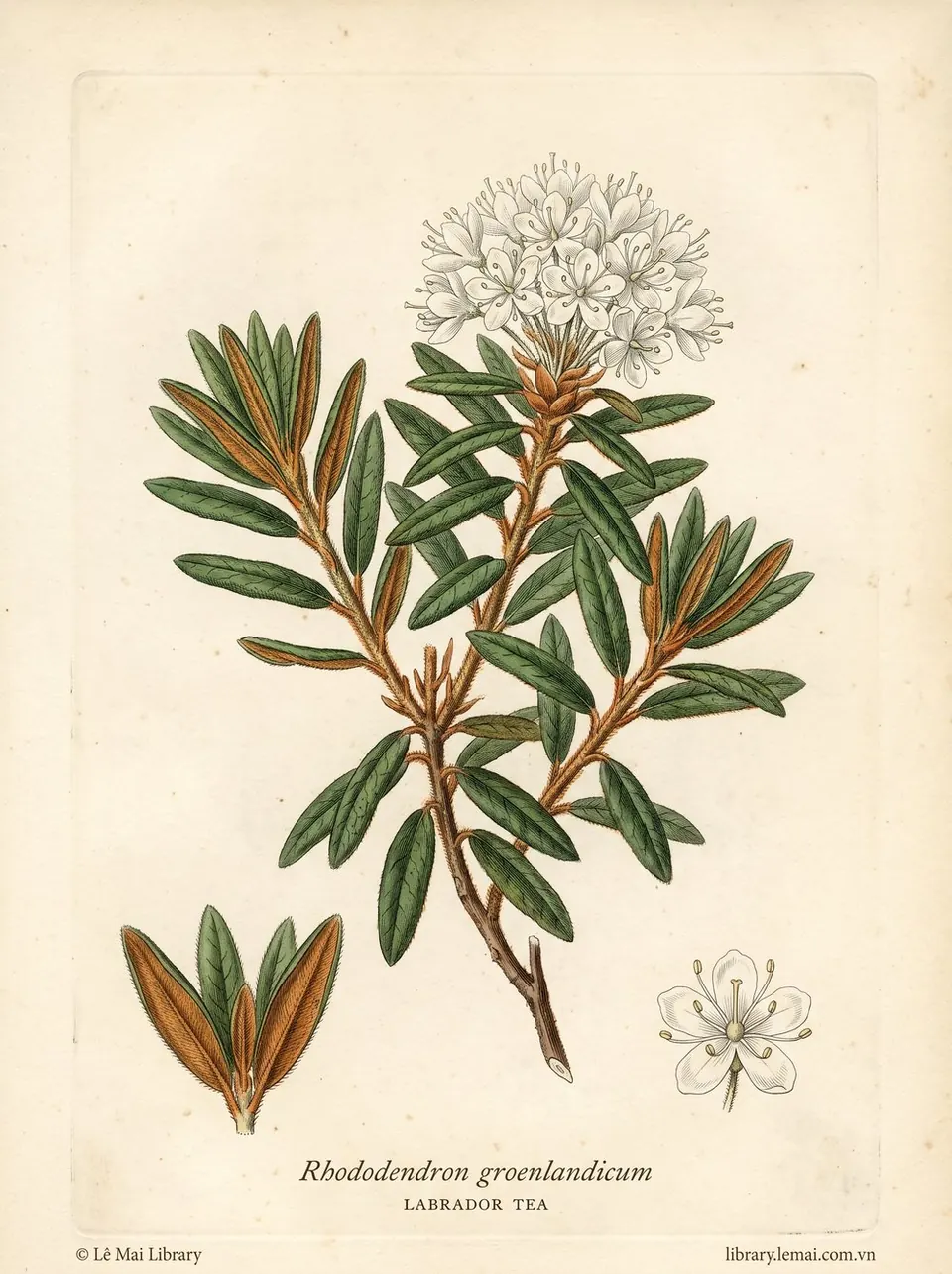
ラブラドルティー
Trà Labrador
Rhododendron groenlandicum
Greenland moss, Ledum groenlandicum, Ledum palustre ssp. groenlandicum
Labrador tea essential oil is steam-distilled from the leaves of Rhododendron groenlandicum, a North American shrub in the heath family, especially from Canada and Greenland; indigenous peoples roasted the leaves and brewed them as tea. Its main component is sabinene (about 30 to 47%), with α-pinene and limonene. Avoid it in pregnancy and breastfeeding, do not take it orally, and keep skin use low.
Updated 6 Nov 2026 · Lê Mai Team
Monoterpene content above 80 percent. Potential hepatotoxicity if taken orally in large amounts.
Contraindicated in pregnancy and breastfeeding due to lack of safety data.
Oral use not recommended. Dermal levels should be kept low.
| Sabinene | 30.0 – 47.0 % |
| α-Pinene | 5.9 – 14.0 % |
| (+)-Limonene | 7.7 – 10.0 % |
| β-Selinene | 0.3 – 9.6 % |
| Terpinen-4-ol | 2.3 – 5.8 % |
| γ-Terpinene | 2.7 – 5.4 % |
| Myrcene | 0.9 – 5.0 % |
Rhododendron groenlandicum is a North American shrub, particularly in Canada and Greenland.
The leaves were traditionally roasted and brewed as tea by indigenous peoples. Steam distillation yields the essential oil.
Family Ericaceae, same family as rhododendrons and blueberries.
Distinct from Ledum palustre (marsh Labrador tea), which contains potentially neurotoxic ledol.
High sabinene content is characteristic of Quebec-sourced oil.