Sabinyl acetate
(Z)-4-Methylene-1-(1-methylethyl)bicyclo[3.1.0]hexan-3-yl ethanoate
cis-Sabinyl acetate · cis-4-Thujanyl acetate
化学組成 · Constituent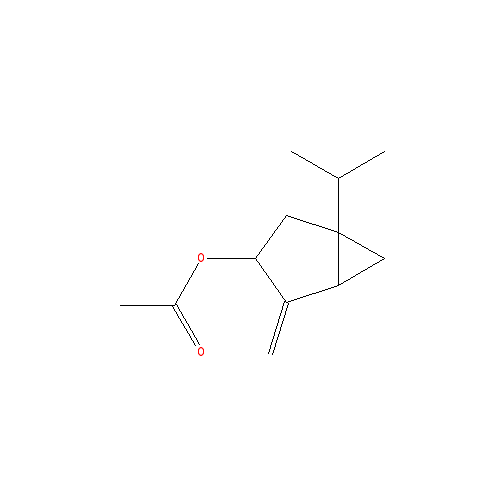
(Z)-4-Methylene-1-(1-methylethyl)bicyclo[3.1.0]hexan-3-yl ethanoate
cis-Sabinyl acetate · cis-4-Thujanyl acetate
化学組成 · Constituent
Sabinyl acetate is one of the few toxic essential oil esters. It presents significant reproductive toxicity in animals.
Reproductive. A fraction of Spanish sage oil containing 50 percent sabinyl acetate injected subcutaneously into pregnant mice on gestational days 6 to 15 at 15, 45 and 135 mg/kg was dose-dependently abortifacient in all groups. Savin oil with 50 percent sabinyl acetate subcutaneously prevented implantation in mice at 45 and 135 mg/kg but not at 15 mg/kg, when given on gestational days 0 to 4. Plectranthus oil with about 60 percent sabinyl acetate, given orally at 0.5, 2.5 or 5.0 mg/kg, dramatically increased fetal resorption and fetal toxicity in pregnant rats.
A pregnancy-safe dose is undetermined but will be below 1 mg/kg oral.
| Savin | 19.1 – 53.1 % |
| Sage (Spanish) | 0 – 6.6 % |
| Yarrow (green) | 3.7 % |
| Boldo | 2.4 % |
Plectranthus oil is not commercially available. Savin and Spanish sage oils must be avoided entirely in pregnancy.