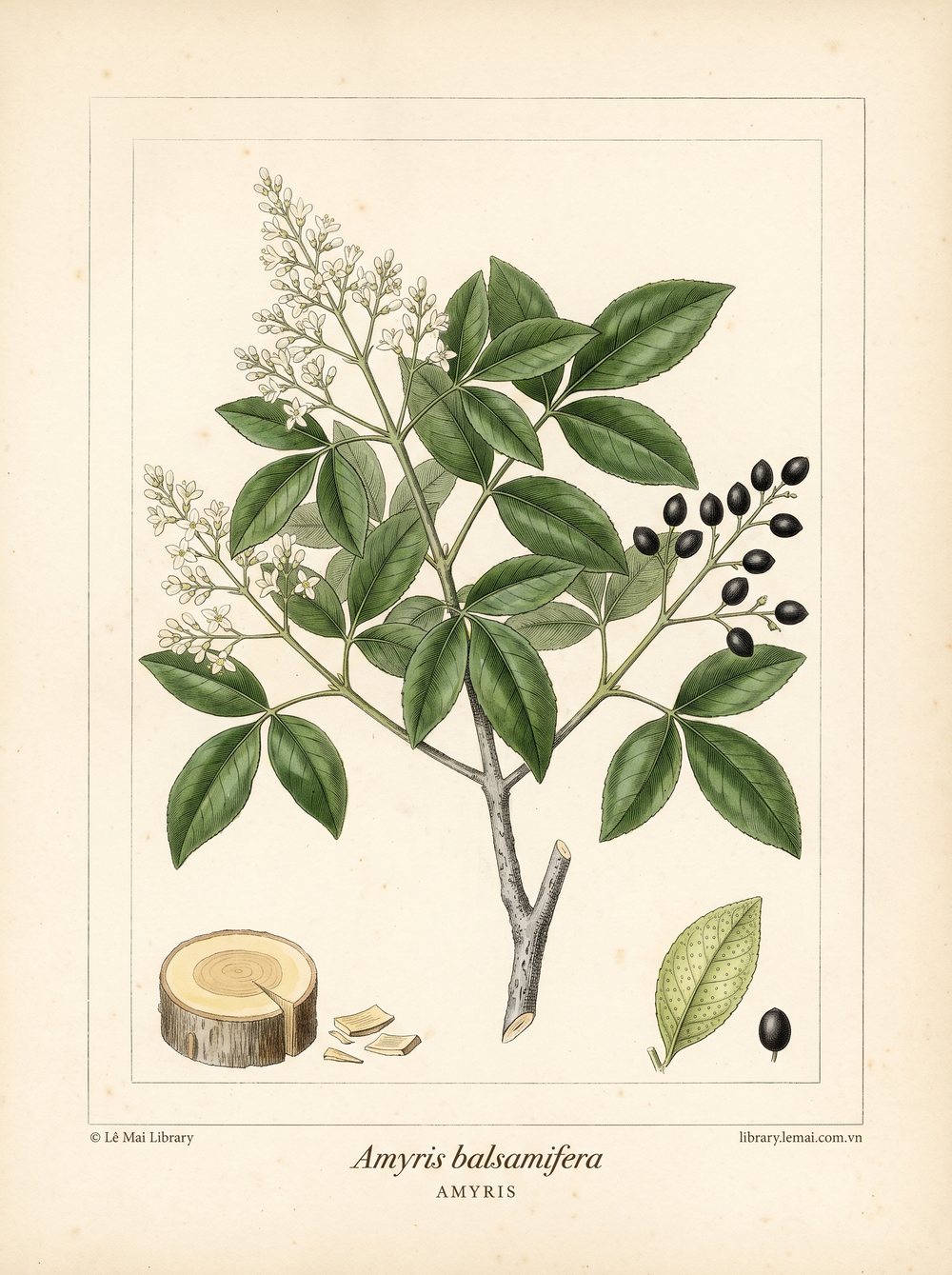
アミリス
Gỗ Amyris, Đàn hương Tây Ấn
Amyris balsamifera
West Indian sandalwood, Balsam torchwood
No known hazards for amyris oil or any of its constituents.
Acute oral LD50 in rats is 5.58 g/kg — very low acute toxicity.
Contains no known carcinogens. γ-Eudesmol and β-sesquiphellandrene display anticarcinogenic properties.
| Valerianol | 15.1 – 21.5 % |
| α-Eudesmol | 4.4 – 16.2 % |
| 7-epi-α-Eudesmol | 0 – 10.7 % |
| 10-epi-γ-Eudesmol | 5.3 – 9.7 % |
| Elemol | 6.6 – 9.1 % |
| β-Sesquiphellandrene | 1.5 – 8.6 % |
| γ-Eudesmol | 6.6 – 8.0 % |
| β-Eudesmol | 3.2 – 7.9 % |
| α-Zingiberene | 0 – 5.2 % |
Amyris balsamifera belongs to the Rutaceae family (citrus family), not Santalaceae (true sandalwood family).
The tree grows in the Caribbean and Central America. Oil is extracted from aged, resinous heartwood.
The species is listed as endangered by the state of Florida, USA. Mainly produced in Haiti, with some production in the Dominican Republic, Jamaica, Venezuela.
Also known as West Indian sandalwood — misleading name as amyris is not true sandalwood.
Amyris is often used as inexpensive substitute for sandalwood (Santalum album) in fragrance formulations.
Amyris scent is warm, soft, woody-balsamic. Commonly used as base note in perfumes and as fixative.
Much lower cost than true sandalwood, making it a popular choice for budget-friendly formulations.