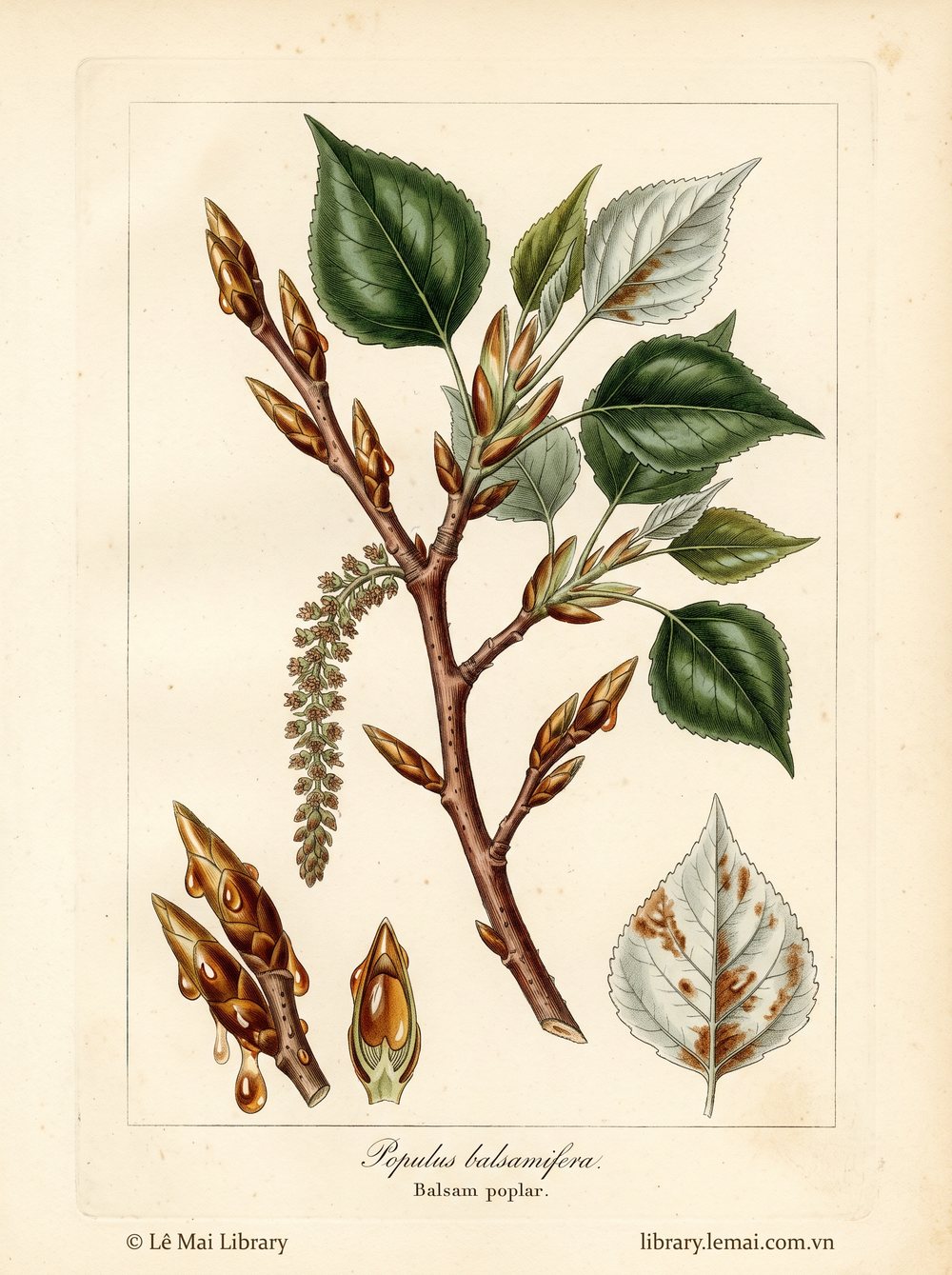
バルサムポプラ
Dương Balsam
Populus balsamifera
Hackmatack, Tacamahac, Black poplar, Balm of Gilead (North America)
No specific contraindications.
Theoretical drug interaction via CYP2D6, as farnesene and α-bisabolol inhibit this enzyme. Consult a physician if taking oral medication metabolized by CYP2D6.
Available α-bisabolol data suggest balsam poplar is unlikely to be hazardous in pregnancy.
| α-Bisabolol | 27.4 % |
| δ-Cadinene | 6.9 % |
| (E)-Nerolidol | 5.8 % |
| γ-Curcumene | 4.6 % |
| α-Eudesmol | 3.5 % |
| δ-Amorphene | 3.3 % |
| γ-Muurolene | 3.1 % |
| γ-Eudesmol | 2.4 % |
| β-Curcumene | 2.3 % |
| (E)-α-Bergamotene | 2.2 % |
| (E)-β-Farnesene | 1.9 % |
Populus balsamifera is a deciduous tree of North America. The flower buds exude a thick, sticky aromatic resin. The species epithet 'balsamifera' means 'balsam-bearing'.
The essential oil is steam-distilled from the buds. Production is limited and the oil is uncommon in commerce.
Family Salicaceae. In North America the tree is also called Balm of Gilead, a name that in Europe refers to Commiphora opobalsamum.
Limited production. The characteristic note is often used to evoke northern coniferous forest air.