Một dự án của Lê Mai A Lê Mai project · go to lemai.com.vn

Frankincense

Nhũ hương, Trầm hương Ả Rập

Boswellia spp.

Olibanum, Boswellia frereana, Boswellia papyrifera, Boswellia sacra, Boswellia carteri, Boswellia serrata, Boswellia neglecta, Boswellia rivae

Burseraceae · Nhựa · Gum resin · Steam-distilled

Frankincense (olibanum) essential oil is steam-distilled from the gum resin of Boswellia species in the Burseraceae family. At least 5 species are traded, and most oil comes from Somalia, with the rest from Yemen and India. Its chemistry varies by species, with Boswellia frereana high in α-pinene (41 to 80%). The resin has been used in religious ritual for at least 3000 years.

Updated 6 Nov 2026 · Lê Mai Team
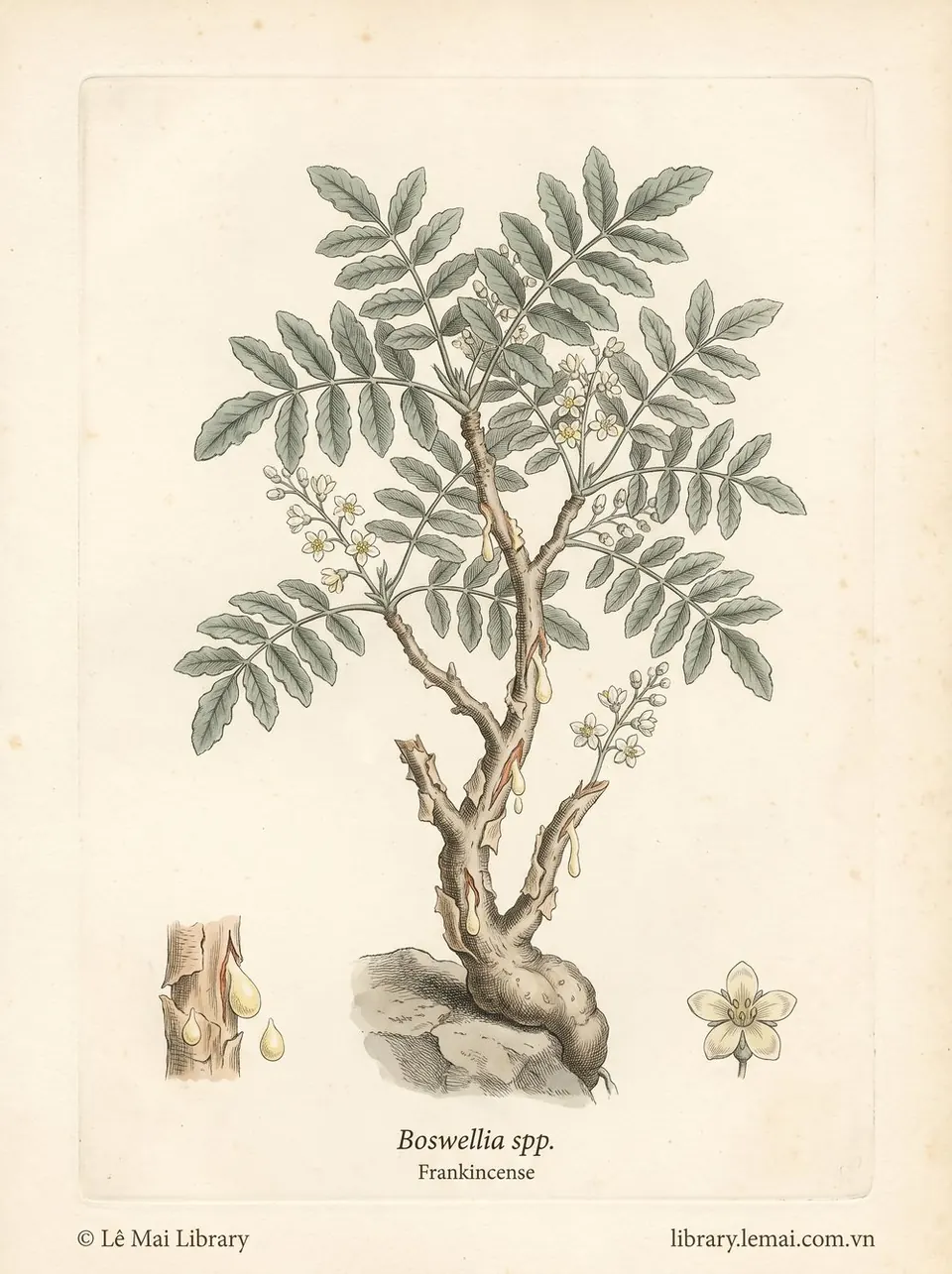
Botanical illustration of Boswellia spp.; resin used to extract Frankincense essential oil
Frankincense essential oil, extracted from the resin of Boswellia spp.. Botanical illustration, Lê Mai Library.

Safety

Skin sensitization if oxidized

Oxidation products of α-pinene, (+)-limonene and δ-3-carene may sensitize skin. Store in dark, sealed, refrigerated container.

A 65-year-old aromatherapist with multiple sensitivities reacted to 5 percent frankincense oil and weakly to 1 percent, an isolated case.

B. serrata may contain α-thujone and β-thujone at low concentrations. Thujone is potentially neurotoxic but levels in frankincense are insignificant.

B. serrata may also contain estragole at low concentrations, a theoretical carcinogen risk.

Likely not hazardous in pregnancy based on data for sabinene, α-pinene, (+)-limonene and octyl acetate.


Usage guidelines

Storage
Dark, sealed, refrigerated; add antioxidant

Chemistry

Volatile constituents
α-Pinene (B. frereana)41.7 – 80.0 %
α-Pinene (B. sacra α-pinene CT)10.3 – 51.3 %
α-Thujene (B. serrata)26.2 – 47.4 %
α-Phellandrene (B. sacra)0 – 41.8 %
Octyl acetate (B. papyrifera)50.0 – 60.0 %
(+)-Limonene (B. sacra)6.0 – 21.9 %
(+)-Limonene (B. rivae)28.0 %
Sabinene0 – 21.0 %
β-Pinene (B. sacra)0 – 9.1 %
β-Caryophyllene (B. sacra)1.9 – 7.5 %
Incensol (B. papyrifera)2.1 – 2.7 %

Botanical source

Frankincense (olibanum) is the oil distilled from the gum resin of Boswellia species in the Burseraceae family. At least 5 species are commercially used with markedly different chemistry:

Boswellia frereana, Somalia/Oman, high α-pinene (41 to 80 percent). Boswellia papyrifera, Eritrea/Ethiopia/Sudan, high octyl acetate (50 to 60 percent). Boswellia sacra (= B. carteri), Saudi Arabia/Oman/Yemen/Somalia, α-pinene or (+)-limonene chemotype. Boswellia serrata, India, high α-thujene. Boswellia neglecta and B. rivae, Ethiopia/Somalia, niche.

For many years the Latin names of frankincense species have been confused. B. carteri and B. sacra are now considered the same species. Most commercial oil comes from Somalia (mainly B. frereana), with the rest from Yemen and India.


Quality

Species identification is often unclear on commercial labels. Some oils have been misattributed. Buy from reputable suppliers, request a certificate of analysis.


Origin, season and context


Perfumes featuring this note

Series 3 Incense: AvignonComme des Garçons · 2002 · main note
Avignon (Series 3 Incense)Comme des Garçons · 2002 · main note
Les Absolus d'Orient: Encens MythiqueGuerlain · 2012 · main note
L'OrphelineSerge Lutens · 2014 · main note
Interlude Man heart

Based on note lists published by each house. Fragrance names and marks belong to their owners.


Notes

B. sacra has been proposed by UNEP-WCMC for CITES addition to the threatened plant list. Sustainable sourcing is a major concern for the industry.

Frankincense has been used in religious ritual for at least 3000 years, ancient Egyptian, ancient Jewish (Temple incense), Christian (one of the three Magi gifts). 'Olibanum' comes from Arabic 'al-luban'.


At Lê Mai

Buy Frankincense Essential Oil No.049

Found in