α-Bisabolol
(R*,R*)-α,4-Dimethyl-α-(4-methyl-3-pentenyl)-3-cyclohexene-1-methanol
2,10-Bisaboladien-7-ol · Bisabolol · Camilol · Levomenol
化学組成 · Constituent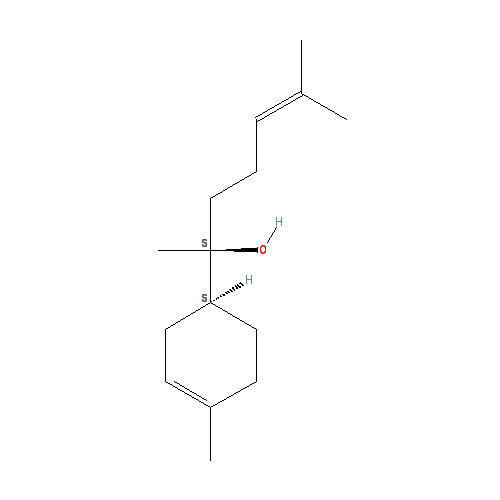
(R*,R*)-α,4-Dimethyl-α-(4-methyl-3-pentenyl)-3-cyclohexene-1-methanol
2,10-Bisaboladien-7-ol · Bisabolol · Camilol · Levomenol
化学組成 · Constituent
α-Bisabolol is a principal constituent of German chamomile and several wood oils. The compound is safe at practical use levels.
Skin. Non-phototoxic at 3 and 15 percent in guinea pigs. The compound increased 5-fluorouracil permeation through human skin 17-fold and triamcinolone acetonide 73-fold, suggesting a role as a skin penetration enhancer.
Oral. Acute oral LD50 is 15.25 mL/kg in rats, 15.1 mL/kg in mice. Rat oral LD50 also reported above 5 g/kg. Mouse intraperitoneal LD50 is 633 mg/kg.
Subchronic. Gavage at 2 mL/kg in rats for 28 days caused dose-dependent motor agitation and urinary ketone reaction. At 3 mL/kg, 20 percent mortality and liver dysfunction in female rats occurred. Dermal 1,000 mg/kg/day for 28 days reduced absolute liver weight in females and increased relative testes weight in males.
Reproductive. Gavage up to 1 mL/kg in rats and rabbits on gestation days 6–15 produced no teratogenic effects. At 3 mL/kg, fetal numbers were reduced in both species.
Mutagenicity. Non-mutagenic in the Ames test with and without S9. Protected against urethane-induced mutation in fruit flies.
| Chamomile (German) | 1.6 – 60.1 % |
| Balsam poplar | 27.4 % |
| Sage (blue mountain) | 27.1 % |
| Sandalwood (Western Australian) | 4.9 – 15.0 % |
| Sandalwood (East African) | 5.1 % |
| Phoebe | 3.3 – 3.6 % |
| Chaste tree | 0 – 2.7 % |
| Valerian (European) | 0 – 1.9 % |
| Myrtle (bog) | 1.0 % |
α-Bisabolol is highly valued in sensitive, irritated and infant skin care. The compound has mild anti-inflammatory and antibacterial activity.
The (R)-α-bisabolol form has better biological activity than (S)-, though both are used commercially.