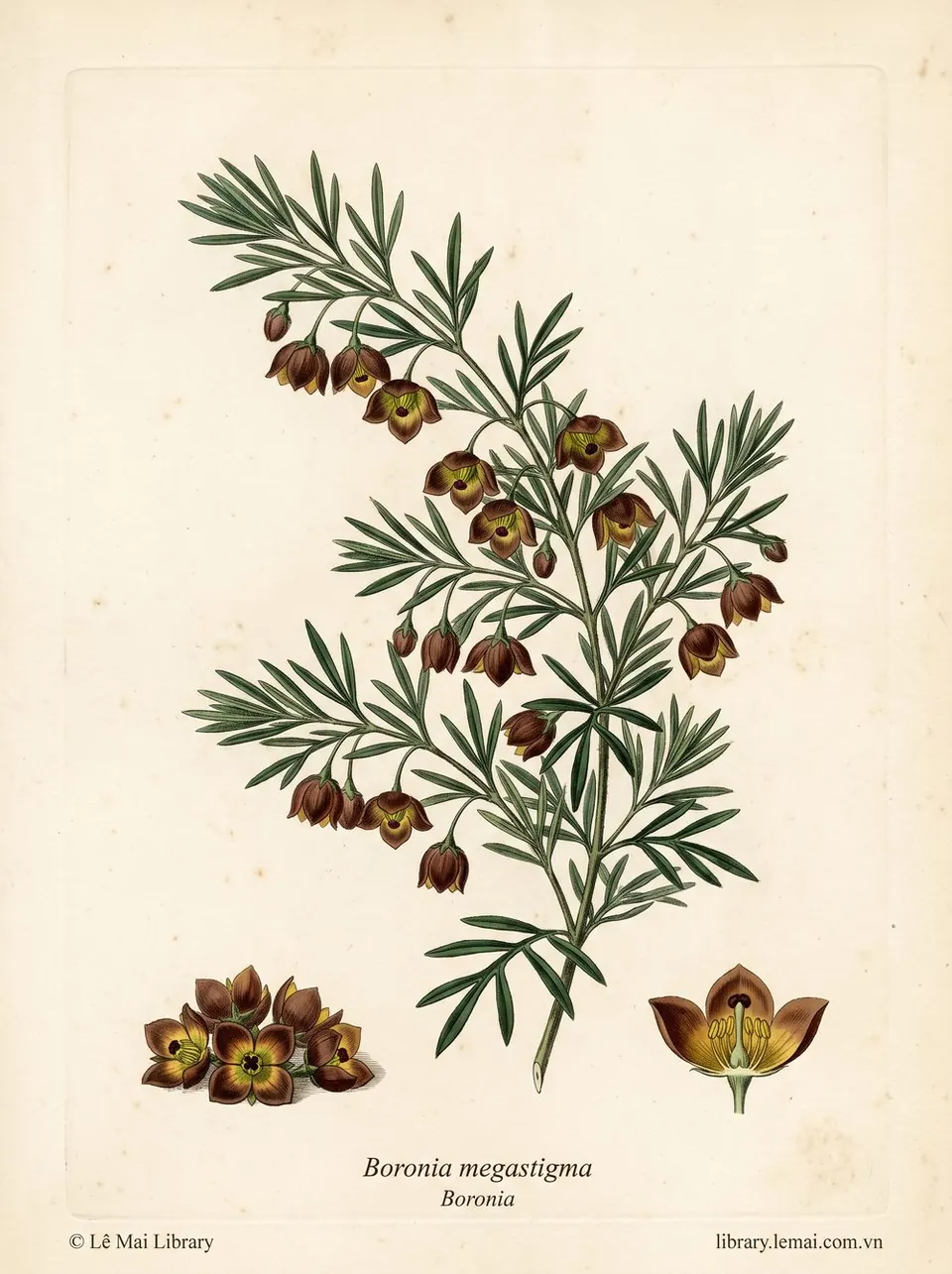
ボロニア
Boronia
Boronia megastigma
Brown boronia
Boronia absolute is solvent-extracted from the flowers of Boronia megastigma, a small citrus-family shrub endemic to Western Australia, with flowers dark brown outside and yellow inside. Its main component is (E)-β-ionone (about 14.9%). Production is tiny, it is prized in fine perfumery, and ionones rarely cause skin reactions.
Updated 6 Nov 2026 · Lê Mai Team
No specific contraindications in available data.
Ionones tend to be non-reactive on the skin.
| (E)-β-Ionone | 14.9 % |
| Heptadecene | 14.6 % |
| (Z)-Methyl cinnamate + N-tiglamide | 9.3 % |
| (E)-Methyl cinnamate | 6.7 % |
| (E)-Cinnamic acid | 4.3 % |
| Dodecyl acetate | 3.8 % |
| Acetoxylinalool | 2.4 % |
| Hydroxymegastimenone | 2.4 % |
| Hydroxylinalyl decanoate | 2.2 % |
| (Z)-Cinnamic acid | 1.9 % |
| Hydroxylinalyl octanoate | 1.8 % |
| Hydroxylinalyl tridecanoate | 1.4 % |
| Dihydro-β-ionone | 1.3 % |
| Methyl jasmonate | 1.2 % |
| Sesquicineole | 1.2 % |
Boronia megastigma is a small shrub endemic to Western Australia, with flowers that are deep brown on the outside and yellow within, carrying a warm, deep scent reminiscent of jasmine and freesia.
The absolute is solvent-extracted from the flowers. Very limited production.
Family Rutaceae. Three distinct chemotypes may exist, each with its own constituent profile.
Among the most expensive absolutes in perfumery. Rarely used at significant concentration in any application.