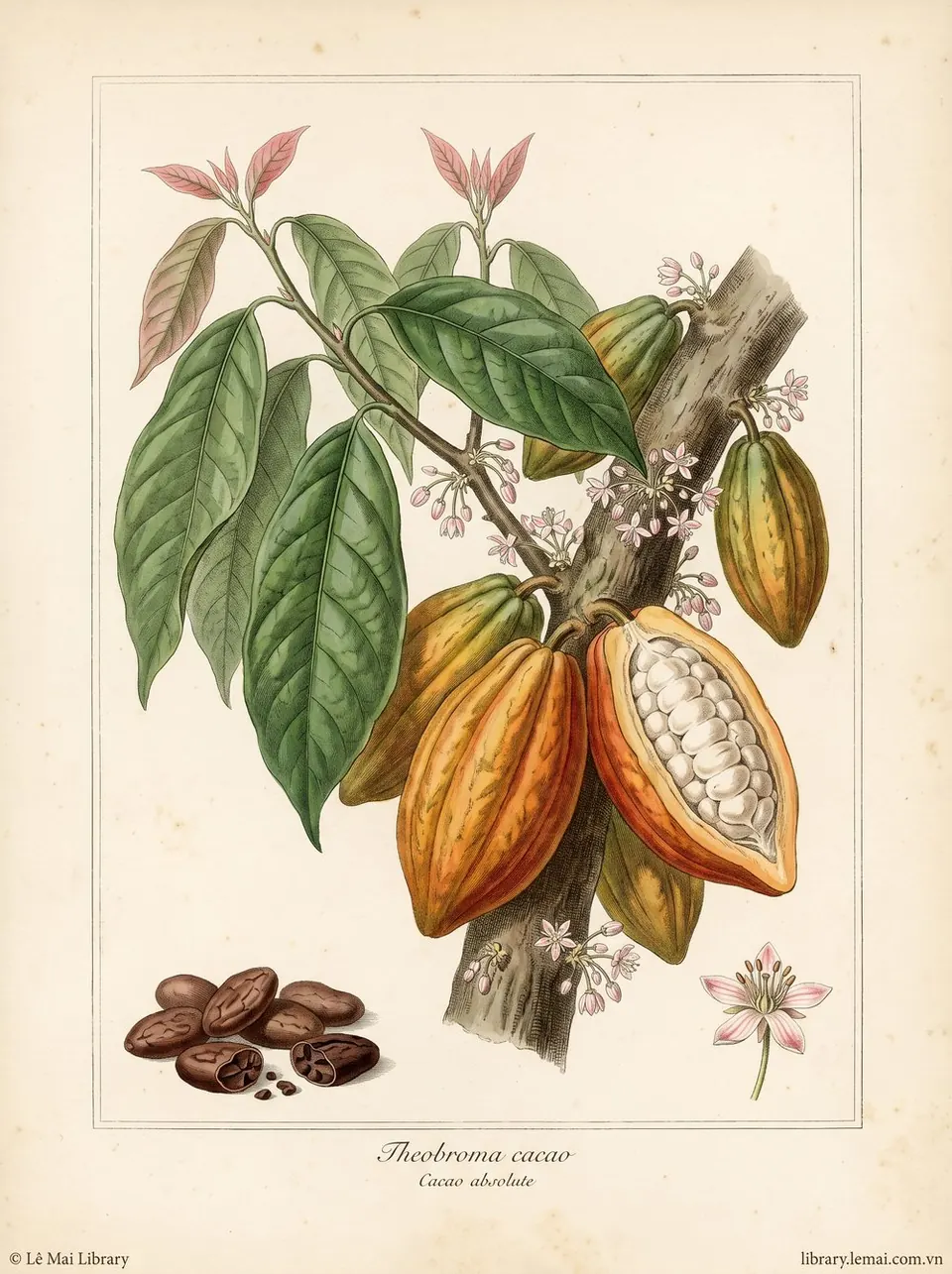
カカオ・アブソリュート
Ca cao absolute
Theobroma cacao
Cocoa absolute, Cocoa extract, Cacao CO2 extract
Cacao absolute is solvent-extracted from fermented, dried and roasted beans of Theobroma cacao, a member of the mallow family produced in Côte d'Ivoire, Ghana and Ecuador. It smells of dark chocolate, cocoa powder and roasting, slightly earthy and woody, with dried fruit and a bitter edge; pyrazines such as tetramethylpyrazine give the roasted note. The absolute is dark brown and may discolor products; it is used in gourmand perfume and candles.
Updated 4 Nov 2026 · Lê Mai Team
Dark chocolate, cocoa powder, roast, slightly earthy and woody. Dried-fruit and bitter facets. Not very sweet unless paired with vanilla.
Cacao absolute has no dedicated standard in the IFRA 51 index. Cocoa beans are a food; cocoa extracts are widely used in food flavours.
The absolute is dark brown and can discolour products. Store dark, sealed and cool.
| Tetramethylpyrazine | present |
| 2,3,5-Trimethylpyrazine | present |
| 3-Methylbutanal | present |
| Phenylacetaldehyde | trace |
| Theobromine (non-volatile) | present |
Côte d'Ivoire · Ghana · Ecuador
| Le Baiser du Dragon | Cartier · 2003 · heart |
| Les Élixirs Charnels: Gourmand Coquin | Guerlain · 2008 · heart |
| Tobacco Vanille | heart |
| Tobacco Chocolat | main note |
Based on note lists published by each house. Fragrance names and marks belong to their owners.
Fresh cocoa beans barely smell of chocolate. The odour forms in three stages: fermentation with the pulp, drying and roasting. Fermentation creates precursors; roasting forms pyrazines and Strecker aldehydes through Maillard reactions.
The absolute is solvent-extracted from roasted, ground beans. Cocoa butter makes up about half the bean's weight and must be separated so the absolute dissolves in ethanol. CO2 extracts are also produced and are usually lighter in colour.
Cocoa odour has several families: pyrazines for roasted and nutty notes, 3-methylbutanal for malt, phenylacetaldehyde for a honeyed floral note. Theobromine is non-volatile and does not contribute odour directly.
In perfumery cacao absolute serves gourmand, oriental and woody fragrances. It pairs with patchouli, vanilla, tonka and orange. Its dark colour limits dosage in pale products.
Vietnam grows cacao in the Central Highlands and the Mekong Delta, but output is small next to West Africa. Côte d'Ivoire and Ghana supply most of the world's cocoa beans.
Cacao absolute is a near-black brown paste and can partly crystallise when cold. It is usually diluted in ethanol and left to settle for a few days. In soap and candles its dark colour affects the product colour. Many chocolate notes in modern perfume are built from synthetics such as pyrazines and vanillin, with cacao absolute adding natural depth.