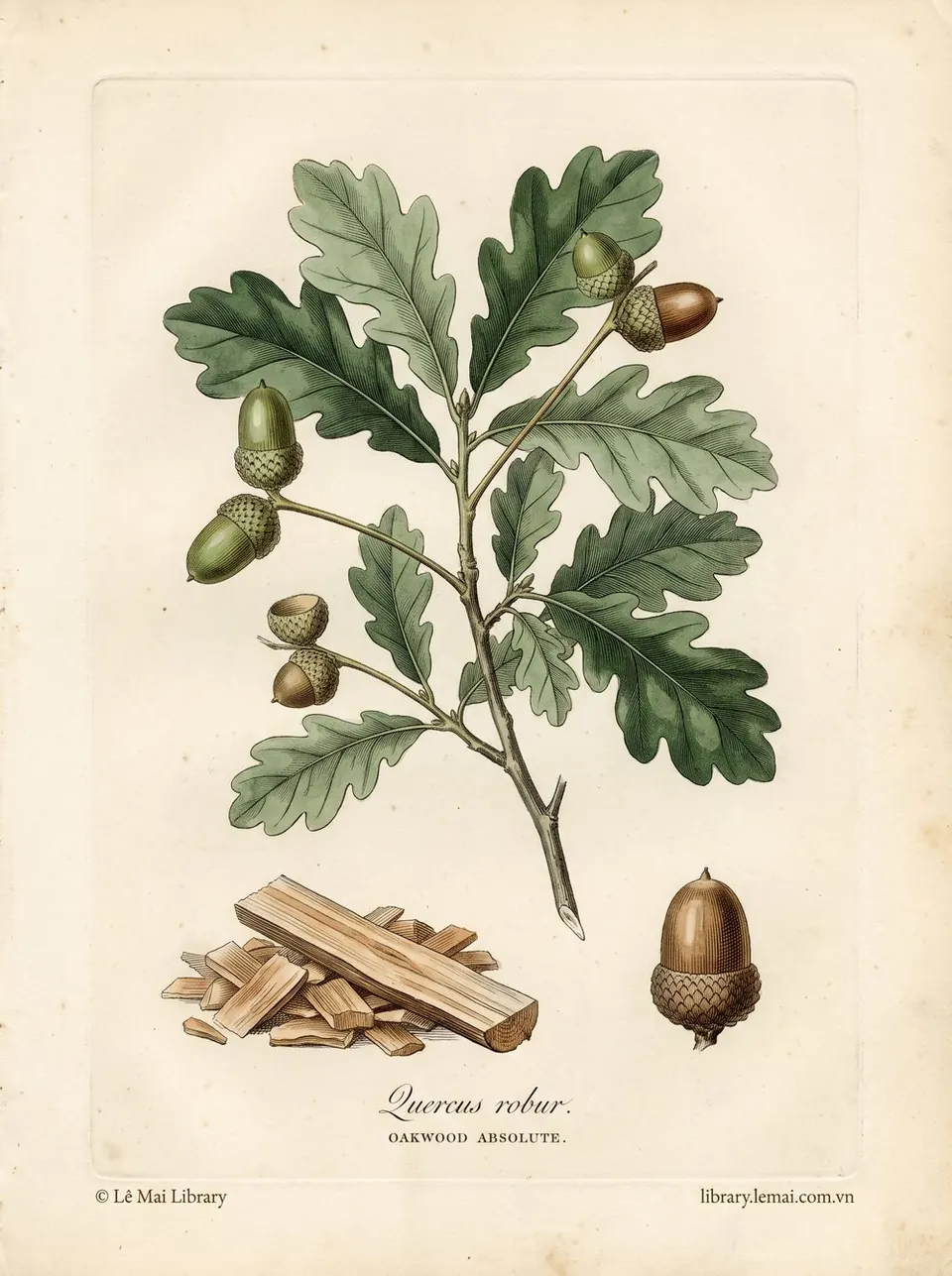
オークウッド・アブソリュート
Gỗ sồi absolute
Quercus robur, Quercus petraea, Quercus alba
Oak absolute, Oak chips extract, Bois de chêne absolue
Oakwood absolute is solvent-extracted from chips of oak wood, Quercus robur, Quercus petraea and Quercus alba, members of the beech family and the classic barrel woods for wine and spirits; it is produced in France and the United States. It smells of barrel, vanilla, coconut, dry wood and a little smoke, evoking whisky and cognac; its key odorants are oak lactone and vanillin. It is often used in boozy, woody and gourmand perfumes.
Updated 4 Nov 2026 · Lê Mai Team
Barrel, vanilla, coconut, dry wood, a little smoke and clove. Warm, sweet and dry, evoking whisky and cognac.
Oakwood absolute has no dedicated standard in the IFRA 51 index. Eugenol, if present, is IFRA-restricted (2023) and an EU-labelled allergen above threshold.
Store dark, sealed and cool.
| cis- and trans-Oak lactone | present, odour-defining |
| Vanillin | present |
| Eugenol | present |
| Guaiacol | present in toasted wood |
| Syringaldehyde | present |
France · United States
European oak (Quercus robur, Q. petraea) and American white oak (Q. alba) are the barrel woods for ageing wine and spirits. During ageing the liquid draws aromatic compounds from the wood: lactones, vanillin and phenols. These are also the odorants of oakwood absolute.
Oak lactone, also called whisky lactone, gives a coconut and sweet-wood note. Vanillin comes from lignin breakdown. When barrels are toasted inside, vanillin, guaiacol and smoky phenols increase.
An absolute is made in two steps. The raw material is extracted with a non-polar solvent such as hexane to give a waxy concrete. The concrete is then washed with ethanol, chilled to precipitate waxes, filtered and freed of alcohol. What remains is the absolute.
The raw material is oak wood, which may be seasoned or toasted as for barrels. Toast level strongly shapes odour: light toast is sweet and coconut-like, heavy toast smoky and coffee-like.
In perfumery oakwood absolute serves boozy, woody, tobacco and gourmand accords. It pairs with cognac, tonka, vanilla, tobacco and leather.
Oakmoss is a lichen growing on oak, not an extract of oak wood. The two materials differ in odour and regulation.
Oakwood absolute is usually a brown paste. On evaluation coconut and vanilla appear first, then dry wood and light smoke. In formulas it gives boozy and tobacco notes a woody depth. It is also used in food and beverage flavours for a barrel note. The toast level should be stated on the certificate.