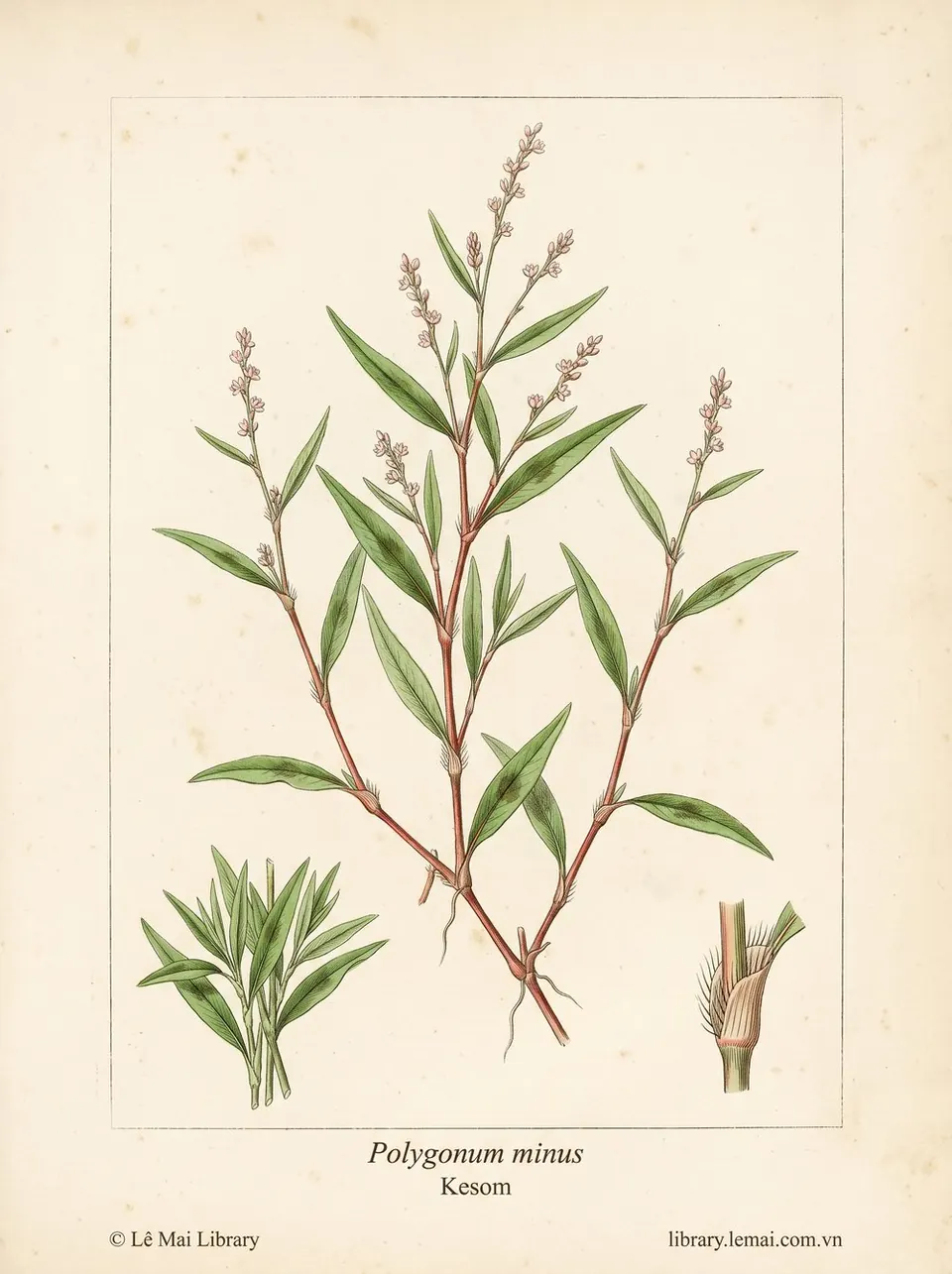
ケソム
Rau răm
Polygonum minus
Polygonum odoratum (Vietnam), Vietnamese coriander, Rau răm
Kesom essential oil is steam-distilled from the aerial parts of Polygonum minus, a creeping Southeast Asian herb in the knotweed family, produced mainly in Malaysia; its fresh leaves are Vietnamese coriander, rau răm. Its main components are dodecanal (44.1%) and decanal (27.7%). It may irritate skin, so always dilute it well.
Updated 6 Nov 2026 · Lê Mai Team
May be a skin irritant, no specific data, but dodecanal (the major constituent at 44 percent) when applied undiluted to rabbits was severely irritating.
Caution with dermal use, dilute adequately.
Contains no known carcinogens.
Polygonum minus in Malaysia (where the oil is produced) and Polygonum odoratum in Vietnamese/US cuisine (rau ram) are likely the same species per modern botanical taxonomy.
| Dodecanal | 44.1 % |
| Decanal | 27.7 % |
| Decanol | 10.9 % |
| β-Caryophyllene | 3.8 % |
| Dodecanol | 2.6 % |
| α-Caryophyllene | 1.5 % |
| Undecane | 1.1 % |
Polygonum minus / odoratum is a creeping herb of Southeast Asia. The fresh leaves are Vietnamese rau ram, an essential herb with fertilized duck eggs, salads, and pho. It has a distinctive pungent, slightly peppery flavor.
The oil is steam-distilled from the aerial parts. Mainly produced in Malaysia.
Family Polygonaceae. Same family as buckwheat and rhubarb.