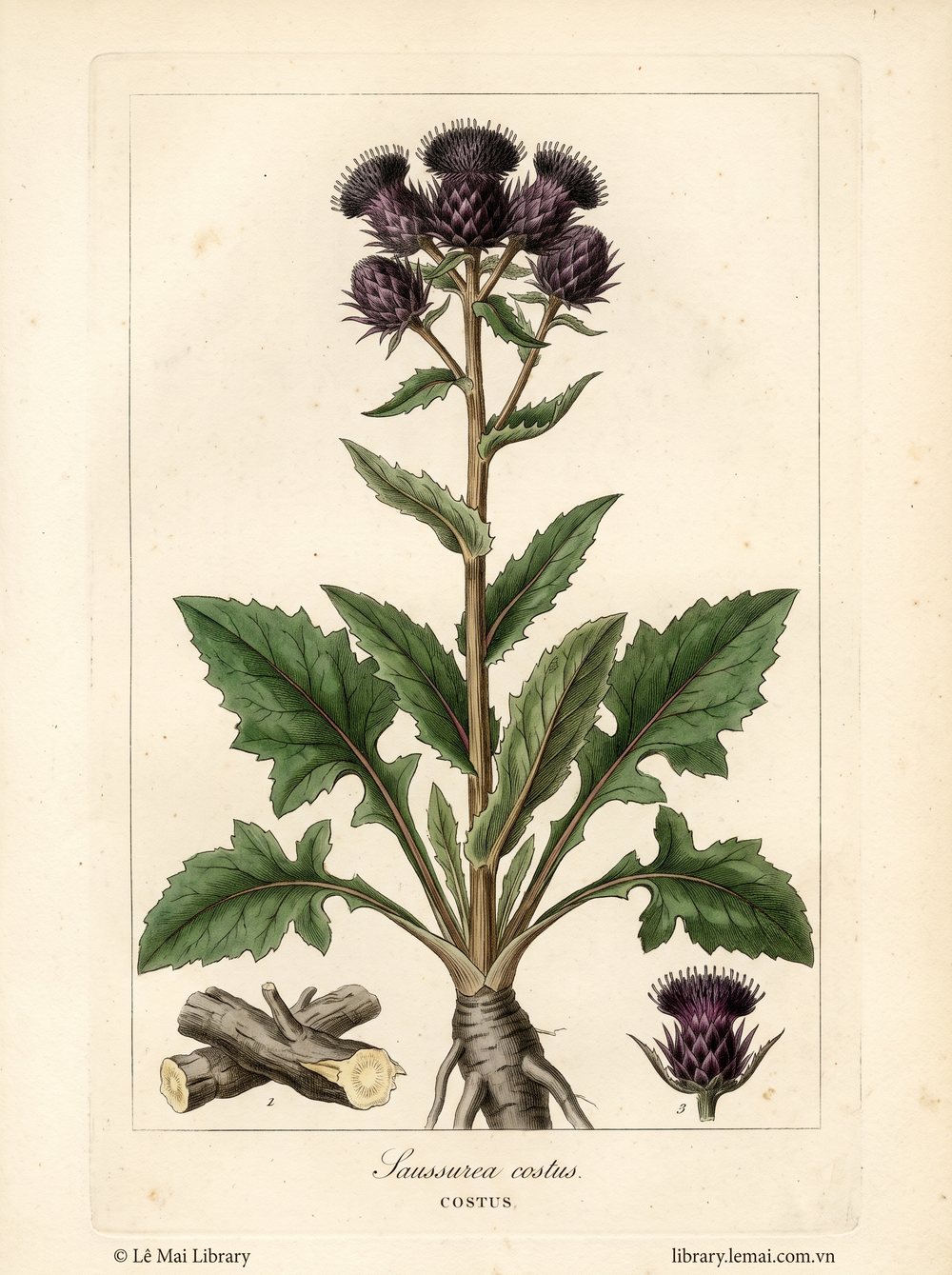
コスタス
Mộc hương
Saussurea costus
Aplotaxis lappa, Aucklandia costus, Saussurea lappa
Fetotoxic (based on costunolide and dehydrocostus lactone). High risk of skin sensitization.
Contraindication: should not be used on the skin.
Broad contraindications: pregnancy, breastfeeding.
IFRA recommends costus oil not be used as a fragrance ingredient due to sensitizing potential, unless shown not to sensitize. Prohibited entirely in the EU.
Maximation test: 25 of 25 volunteers showed sensitization reactions at 4 percent. 16 of 26 at 2 percent. Among the highest-sensitizing essential oils on record.
Sesquiterpene lactones (costunolide, dehydrocostus lactone) are the main sensitizing constituents. Lactone-rich fractions sensitize severely; lactone-free fractions do not, lactones can be removed using aminoethyl-polystyrene polymer.
| Aplotaxene | 20.0 % |
| Dihydrocostus lactone | 15.0 % |
| Costusic acid | 14.0 % |
| Costunolide | 11.0 % |
| Dehydrocostus lactone | 6.0 % |
| Dihydrodehydrocostus lactone | 6.0 % |
Saussurea costus is a perennial herb of the Himalayas. The dried root has traditional uses in Tibetan and Chinese medicine, and in classical Indian perfumery.
The plant is on CITES Appendix I (species threatened with extinction), sourcing requires CITES permit.
Family Asteraceae. The lactones in costus are among the principal causes of contact sensitization to Compositae family plants.
Sensitization data are inconsistent. Concentrations up to 0.01 to 0.05 percent may be safe in most circumstances, but given the species' endangered status and the sensitization risk, the IFRA prohibition is reasonable.
It has been hypothesized that costus oil's anticarcinogenic activity arises partly from immune system stimulation via delayed hypersensitivity reaction to the lactones.