ホースラディッシュ
Cải ngựa
Armoracia rusticana
Cochlearia armoracia, Armoracia lapathifolia
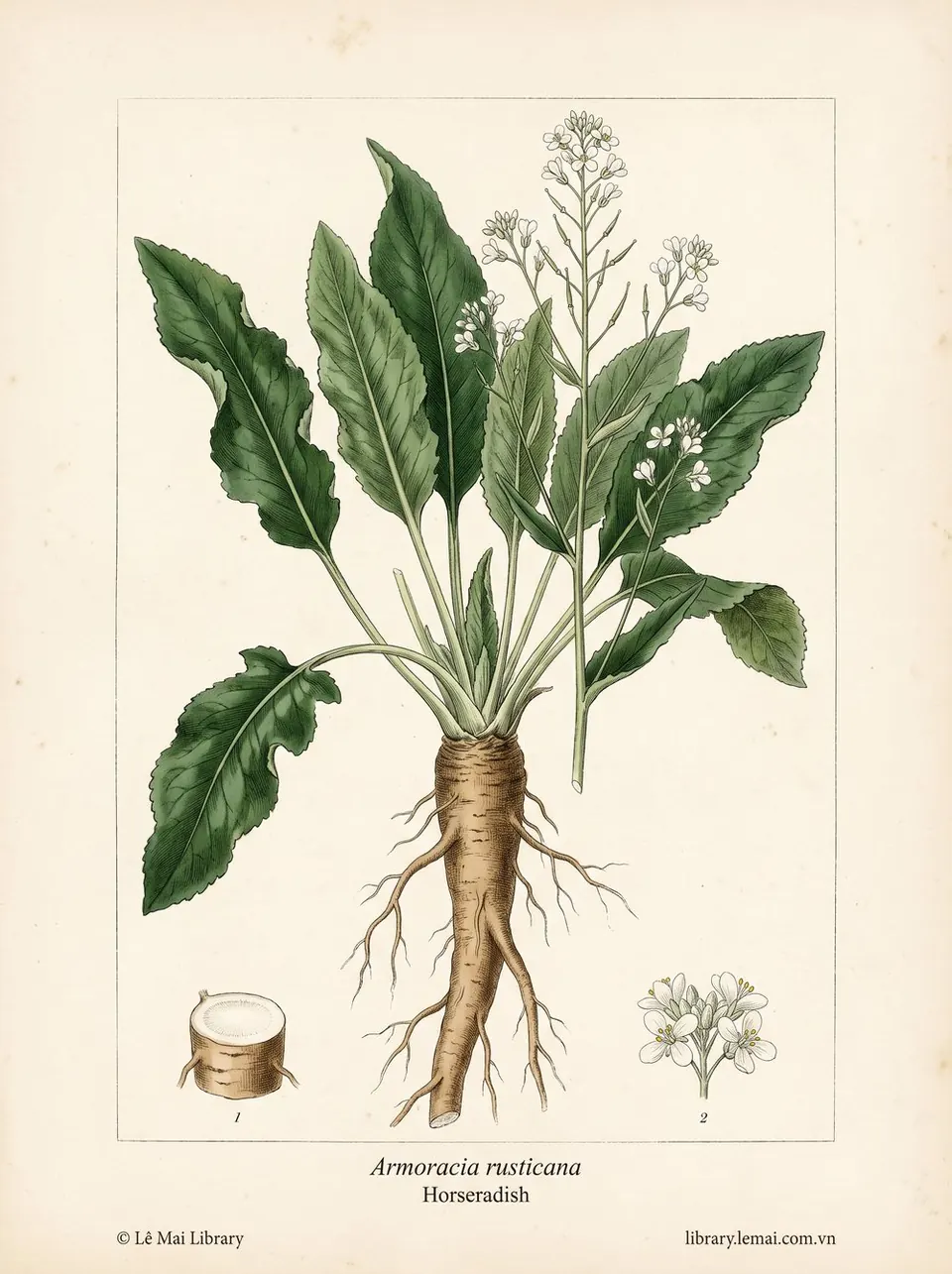
Horseradish essential oil is steam-distilled from the roots of Armoracia rusticana, a perennial in the mustard family from Eastern and Central Europe; the root is a familiar hot condiment. It smells extremely pungent, like mustard; its main components are allyl isothiocyanate (about 44.3 to 55.7%) and 2-phenylethyl isothiocyanate (about 38.4 to 51.3%). It is one of the most hazardous essential oils and severely irritates skin, so it should not be used at all.
Updated 4 Nov 2026 · Lê Mai Team
Toxicity. High risk of skin irritation. High risk of mucous membrane irritation.
Contraindication: should not be used, either internally or externally.
Allyl isothiocyanate is prohibited in fragrances by IFRA and as a cosmetic ingredient in the EU, effectively prohibiting horseradish oil similarly.
One of the most hazardous essential oils.
Allyl isothiocyanate severely irritates skin and mucous membranes. Skin contact has caused blistering.
Allyl isothiocyanate rat oral LD50 is 340 mg per kg, toxic to liver, kidney, blood at 40 mg per kg. Can cause bladder cancer in male rats.
| Allyl isothiocyanate | 44.3 – 55.7 % |
| 2-Phenylethyl isothiocyanate | 38.4 – 51.3 % |
| 4-Pentenyl isothiocyanate | 0.6 – 4.0 % |
| 2-Butyl isothiocyanate | 0 – 2.7 % |
| Allyl thiocyanate | 1.6 – 2.5 % |
Armoracia rusticana is a perennial herb of eastern and central Europe. The large white root is a traditional pungent spice (particularly for roast beef).
The oil is steam-distilled from the roots. Chemistry similar to mustard oil, sulfur-rich isothiocyanate.
Family Brassicaceae. Same family as mustard, cabbage, broccoli.