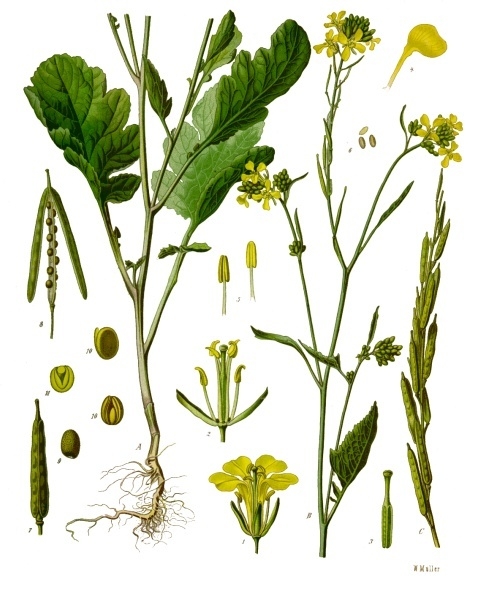
マスタード
Mù tạt
Brassica nigra
Black mustard
Allyl isothiocyanate comprises over 90 percent. Extremely irritating to skin, mucous membranes, and respiratory system.
IFRA prohibits in fragrance entirely. EU prohibits in cosmetics.
Can cause chemical burns on direct skin contact.
DO NOT use in any cosmetic application.
| Allyl isothiocyanate | 90.0 – 95.0 % |
| Allyl cyanide | 1.0 – 3.0 % |
| Carbon disulfide | 0.5 – 2.0 % |
Brassica nigra is black mustard, its seeds being a famous spice in European and Indian cuisines.
Allyl isothiocyanate is released when crushed seeds are catalyzed by myrosinase (an enzyme also present in the seeds). White mustard seeds (Sinapis alba) do not produce allyl isothiocyanate under these conditions.
Fixed oil from the seeds is also called 'mustard oil', markedly different from the distilled essential oil.
Family Brassicaceae (Cruciferae), same family as cabbage and mustard greens.
Listed in for database completeness, but NOT used in cosmetics.
In agriculture, allyl isothiocyanate is sometimes used as a natural soil fumigant.