Methyl cinnamate
Methyl 3-phenyl-2-propenoate
Cinnamic acid methyl ester · Methyl β-phenylacrylate
化学組成 · Constituent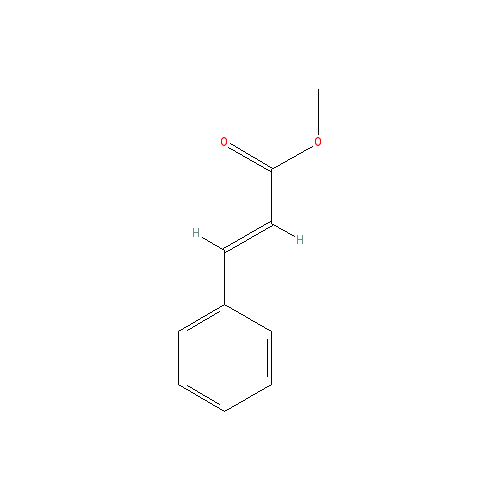
Methyl 3-phenyl-2-propenoate
Cinnamic acid methyl ester · Methyl β-phenylacrylate
化学組成 · Constituent
Methyl cinnamate is a phenylpropenoid ester present at high levels in one chemotype of basil. The compound is minimally skin reactive and non-irritating to mucous membranes.
Skin. Tests at 2 and 10 percent on 25 volunteers showed no irritation or sensitization. Not sensitizing in guinea pigs. Among 102 dermatitis patients sensitive to Peru balsam, 3 reacted to 10 percent methyl cinnamate.
Mucous membranes. In RIFM testing, 15 percent methyl cinnamate was non-irritating to rabbit vaginal tissue. Also non-irritating to rabbit eyes.
Acute toxicity. Acute oral LD50 in rats is 2.61 g/kg. Acute dermal LD50 in rabbits exceeded 5 g/kg.
Mutagenicity. Non-mutagenic in Bacillus subtilis rec assay but genotoxic in Chinese hamster ovary cells. Data is inconsistent.
| Basil (methyl cinnamate CT) | 58.0 – 63.1 % |
| Narcissus | 1.1 – 15.8 % |
| Sugandha | 13.7 % |
| Tomar seed | 12.2 % |
| Jonquil | 7.8 % |
| Boronia | 6.7 % |
| Galangal (greater) | 2.6 – 5.3 % |
| Bakul | 3.6 % |
| Finger root | 3.0 % |
| Peru balsam | tr – 1.7 % |
Methyl cinnamate is rapidly hydrolysed in rats and rabbits to cinnamic acid and methanol. Cinnamic acid is converted mainly to hippuric acid in rats, rabbits, cats, dogs and humans. In humans, 50 to 75 percent of a 6 g oral dose is metabolized to hippuric acid within 4 hours.
Two main geometric isomers exist: (2E)-methyl cinnamate (trans-) and (2Z)-methyl cinnamate (cis-). The trans-isomer dominates in commercial essential oils.