Santalol
(R,Z)-5-(2,3-dimethyltricyclo[2.2.1.0²,⁶]hept-3-yl)-2-methyl-2-penten-1-ol
α-Santalol · β-Santalol · cis-α-Santalol · cis-β-Santalol
化学組成 · Constituent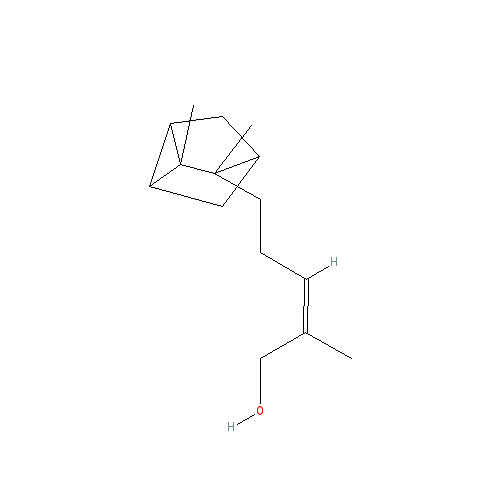
(R,Z)-5-(2,3-dimethyltricyclo[2.2.1.0²,⁶]hept-3-yl)-2-methyl-2-penten-1-ol
α-Santalol · β-Santalol · cis-α-Santalol · cis-β-Santalol
化学組成 · Constituent
Santalol comprises two principal isomers (Z)-α-santalol and (Z)-β-santalol, the dominant constituents of East Indian sandalwood oil. The compound is safe for most users, with low sensitization rates in Caucasian populations.
Skin. At 20 percent it was not irritating on 5 volunteers nor allergenic on 25 volunteers. In a worldwide multicenter study of fragrance-sensitive dermatitis patients, 2 of 178 reacted to 5 percent santalol mixture, a rate of 1.12 percent.
Japanese sensitization. Across 4,266 Japanese patients with cosmetic dermatitis, 57 reacted to 2 percent santalol, a rate of 1.34 percent. Lower concentrations should be used for individuals of East Asian origin.
Oral. Acute oral LD50 in rats was 3.8 g/kg. Acute dermal LD50 in rabbits exceeded 5 g/kg.
Cancer. (Z)-α-Santalol reduced DMBA/TPA-induced skin papilloma incidence from 100 percent to 23 to 40 percent and reduced papilloma numbers by about 10-fold. It also reduced ODC activity, a tumor promotion marker, by 60 to 89 percent. (Z)-β-Santalol shows similar activity. Both isomers significantly inhibited UVB-induced skin cancer in mice.
| Sandalwood (East Indian) | 46.2 – 59.9 % α / 20.5 – 29.0 % β |
| Sandalwood (New Caledonian) | 42.3 % α / 17.5 % β |
| Sandalwood (Western Australian) | 15.3 – 17.0 % α / 4.6 – 5.9 % β |
Santalol is the sesquiterpene alcohol that carries both the pharmacological and sensory character of sandalwood. Its high molecular weight and slow evaporation make it a natural fixative in perfumery.