Phytol
3,7,11,15-Tetramethyl-2-hexadecen-1-ol
2-Phyten-1-ol
化学組成 · Constituent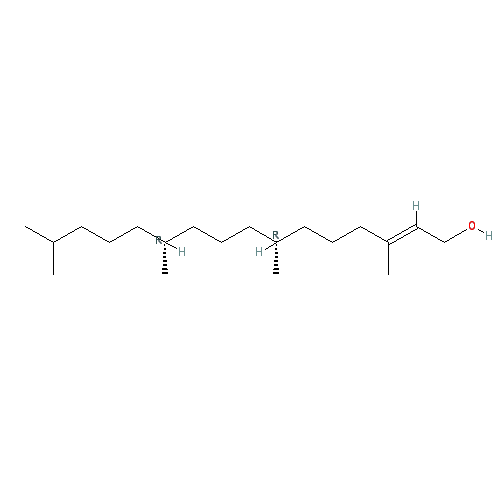
3,7,11,15-Tetramethyl-2-hexadecen-1-ol
2-Phyten-1-ol
化学組成 · Constituent
Phytol is ubiquitous in plants as an ester and decomposition product of chlorophyll, but rarely occurs at significant levels in essential oils. In jasmine absolute it reaches 7 to 12.5 percent.
Skin. Undiluted material was moderately irritating to rabbit skin. At 10 percent on 25 volunteers it was neither irritating nor sensitizing.
Oral. Acute oral LD50 in rats exceeded 5 g/kg. Acute dermal LD50 in rabbits exceeded 5 g/kg.
Refsum's disease. People with Refsum's disease lack phytanic acid hydroxylase and cannot metabolize phytanic acid, which accumulates in plasma and tissues. The rare recessive disorder causes peripheral neuropathy, cerebellar ataxia and retinitis pigmentosa. Affected individuals need to avoid chlorophyll-containing foods.
Dietary profile. Rats, mice, chinchillas and rabbits fed 2 or 5 percent phytol for 3 weeks accumulated phytanic acid in liver and serum. At 5 percent, growth was retarded, livers appeared mottled, and around 50 percent of rats died. At 0.5 percent for 15 months no adverse effects were observed.
| Jasmine | 7.0 – 12.5 % |
In humans, phytol is metabolized in part to CO2, with phytanic acid detected in plasma. Numerous other metabolites are involved.
Phytol is a decomposition product of chlorophyll. Its low volatility and high molecular weight make it useful as a fixative in perfumery.