Isosafrole
1-Propenyl-3,4-methylenedioxybenzene
(E)-Isosafrole · trans-Isosafrole
化学組成 · Constituent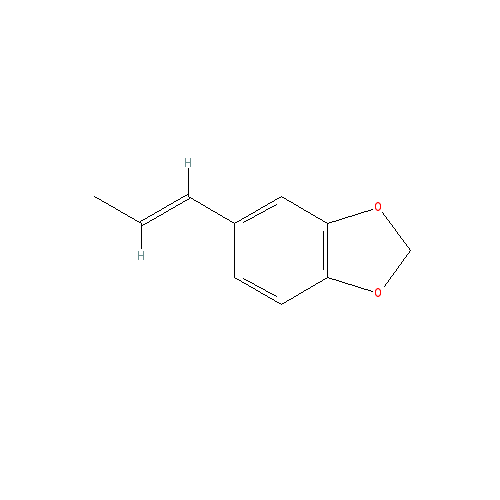
1-Propenyl-3,4-methylenedioxybenzene
(E)-Isosafrole · trans-Isosafrole
化学組成 · Constituent
Isosafrole is the positional isomer of safrole, occurring in trace amounts in ylang-ylang oil. The EU and IFRA strictly restrict it due to hepatocarcinogenic risk similar to safrole.
Oral. Acute oral LD50 is 1.34 g/kg in rats, 2.47 g/kg in mice.
Subchronic. Rats fed 5,000 ppm for 2 years and 10,000 ppm for 11 weeks showed growth retardation, liver enlargement and slight microscopic liver damage at both doses. At the lower dose, 5 of 50 rats had primary liver tumors.
Mutagenicity and cancer. Not mutagenic in the Ames test. Genotoxicity reports are conflicting. Isosafrole is a weak rodent hepatocarcinogen, possibly through a non-genotoxic mechanism. Isomerization of 3'-hydroxy isosafrole to 1'-hydroxysafrole, the proximate carcinogenic metabolite of safrole, is possible at high exposure.
| Ylang-ylang | Trace |
In rats, isosafrole is mainly (79 percent) O-demethylenated to the catechol derivative, some of which is further converted to O-methylated and side-chain-reduced products. Only relatively little of the methylenedioxy group survives, to give the 1',2'-diol (about 2 percent) and 3'-alcohol. Isosafrole is a potent inducer of cytochromes P450 and P448.
Isosafrole occurs together with safrole in nature but at much lower concentrations. Any measure to restrict exposure to safrole in food would also cover isosafrole.