ar-Turmerone
2-Methyl-6-(4-methylphenyl)-2-hepten-4-one
Dehydroturmerone
化学組成 · Constituent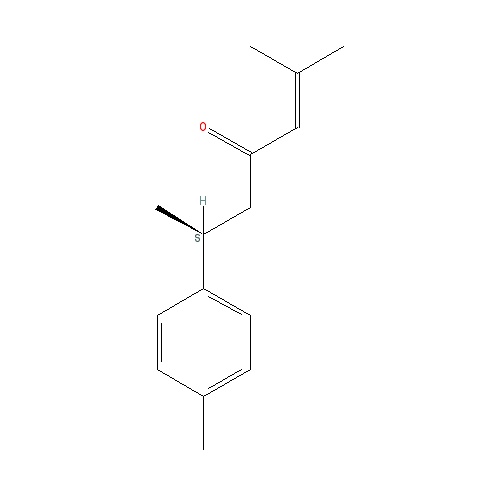
2-Methyl-6-(4-methylphenyl)-2-hepten-4-one
Dehydroturmerone
化学組成 · Constituent
ar-Turmerone is the principal constituent of turmeric rhizome oil at 16 to 28 percent. The 'ar' prefix denotes 'aromatic'. α- and β-turmerone isomers also occur in turmeric. Direct toxicity data are limited, but turmeric rhizome oil is non-toxic, so ar-turmerone is inferred to be safe.
Cardiovascular. ar-Turmerone shows in vitro antiplatelet activity. It has hypoglycemic activity through inhibition of α-glucosidase and α-amylase.
Mutagenicity. A turmeric oil fraction containing 44.5 percent ar-turmerone was antimutagenic.
Cancer. ar-Turmerone is active against sarcoma 180 ascites in mice at 50 mg/kg. It potentiates β-sesquiphellandrene activity 5-fold and aurapten, cyclophosphamide and MeCCNU activity 10-fold. ar-Turmerone induces apoptosis in K562, RBL-2H3, L1210 and U937 cancer cell lines with IC50 of 20 to 50 µg/mL. It strongly inhibits COX-2 and iNOS, correlating with chemopreventive activity.
| Turmeric rhizome | 15.5 – 27.5 % |
ar-Turmerone, together with α- and β-turmerone, defines the character of turmeric rhizome oil. Compared to curcumin, the more well-known constituent of turmeric, ar-turmerone is volatile and present in the essential oil, while curcumin is non-volatile and found in alcoholic extracts or powders.